This volume calculator computes the three-dimensional space inside ten common solid shapes based on their basic dimensions. It removes manual multi-step unit conversions and geometric formulas, so you don't need to juggle cubic roots or imperial fraction conversions by hand. You get an immediate calculation of total volume displayed across metric and US customary units.
Core Geometric Volume Formulas
Calculating volume requires measuring the three-dimensional space enclosed by a closed surface. In mathematical terms, volume measures the capacity of a boundary and always outputs in cubic units (m³, ft³, in³) or capacity units (liters, gallons).
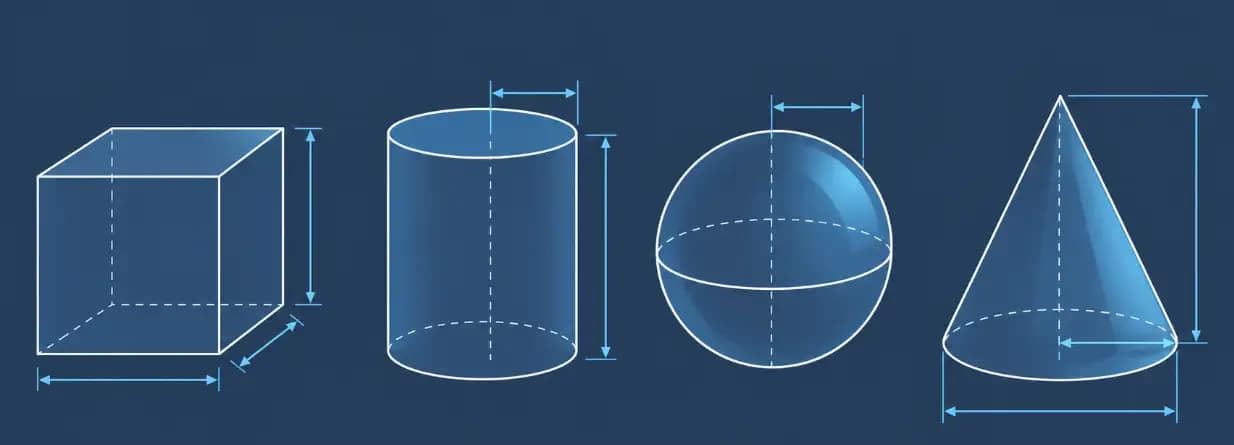
      Rectangular Prism                 Cylinder                      Sphere
        +---------+                      .---.                        .---.
       /         /|                     /     \                      /     \
      +---------+ |                    |       |                    |   r   |
      |         | + h                  |   r   | h                  |  ---* |
      |         |/                      \     /                      \     /
      +---------+                        '---'                        '---'
        w     l
      V = l * w * h                 V = pi * r^2 * h             V = (4/3) * pi * r^3
1. Rectangular Prism (Box or Tank)
A rectangular prism has six rectangular faces. Its capacity depends directly on base surface area multiplied by height. For projects that start with floor dimensions, our square footage calculator provides the initial base area.
- Formula:
V = l · w · h
- Variables:
l = length, w = width, h = height
2. Cylinder (Pipes, Barrels, and Silos)
A cylinder consists of two parallel circular bases of equal radius joined by a curved surface.
- Formula:
V = π · r² · h
- Variables:
r = radius of circular base, h = height
3. Sphere (Balls and Globes)
A sphere is completely symmetrical, defined solely by the distance from its central point to its outer boundary.
- Formula:
V = (4/3) · π · r³
- Variables:
r = radius
4. Cone (Circular Cone)
A right circular cone narrows smoothly from a flat circular base to a single vertex point. Its volume equals exactly one-third of a cylinder with the same base and height.
- Formula:
V = (1/3) · π · r² · h
- Variables:
r = base radius, h = vertical height
5. Pyramid (Rectangular or Square Base)
A pyramid connects a polygonal base to an apex. For standard rectangular pyramids:
- Formula:
V = (1/3) · l · w · h
- Variables:
l = base length, w = base width, h = vertical height
6. Ellipsoid
An ellipsoid is a three-dimensional closed surface whose planar sections are ellipses. Think of a flattened sphere or a regulation rugby ball.
- Formula:
V = (4/3) · π · a · b · c
- Variables:
a, b, c = semi-axes lengths measured from center
Step-by-Step Calculation Examples
Example 1: Finding the Capacity of a Cylindrical Water Tank
Suppose you have a vertical rainwater collection tank with a base diameter of 6 feet and a height of 8 feet. You want to determine how many US gallons it holds.
Calculate the radius: Radius is half the diameter.
r = 6 ft / 2 = 3 ft
Apply the cylinder formula:
V = π · r² · h = π · (3)² · 8 = π · 9 · 8 = 72π ≈ 226.195 ft³
Convert cubic feet to US liquid gallons: There are 7.48052 gallons in one cubic foot.
226.195 × 7.48052 ≈ 1,692.05 gallons
Example 2: Excavating a Rectangular Foundation Trench
A contractor needs to excavate a trench measuring 40 feet long, 3 feet wide, and 18 inches deep. Concrete and dirt hauling orders require volume in cubic yards. If you need dedicated ordering formulas for aggregates, check our cubic yard calculator.
Normalize all measurements to feet: 18 inches equals 1.5 feet (18 ÷ 12).
Calculate cubic feet:
V = l · w · h = 40 · 3 · 1.5 = 180 ft³
Convert cubic feet to cubic yards: One cubic yard contains 27 cubic feet (3 × 3 × 3).
V_yards = 180 / 27 ≈ 6.67 yd³
Unit Conversion Reference
Never multiply raw measurements before converting them to the same unit. Mixing inches with feet or centimeters with meters leads to dimensional scale errors.
| Starting Unit | Target Unit | Multiply By | Exact Factor / Expression |
|---|
| Cubic Inches (in³) | Cubic Feet (ft³) | 0.0005787 | 1 / 1,728 |
| Cubic Feet (ft³) | Cubic Yards (yd³) | 0.037037 | 1 / 27 |
| Cubic Feet (ft³) | US Gallons | 7.48052 | 1,728 / 231 |
| Cubic Meters (m³) | Liters (L) | 1,000 | 10³ |
| Liters (L) | US Gallons | 0.264172 | 1 / 3.785411784 |
| Cubic Meters (m³) | Cubic Yards (yd³) | 1.30795 | 1 / 0.764554857984 |
| Cubic Centimeters (cm³ or mL) | Fluid Ounces (US fl oz) | 0.033814 | 1 / 29.5735295625 |
The Dimensional Power Rule Trap
Linear conversions do not scale directly to volume. A foot is 12 inches, but a cubic foot is not 12 cubic inches.
Because volume covers three dimensions, you must cube the linear factor:
1 ft = 12 in ⟹ 1 ft³ = 12³ in³ = 1,728 in³
Similarly, one meter equals 100 centimeters. Therefore, one cubic meter equals 100³ or 1,000,000 cm³. If your project involves moving items across distances, our speed distance time calculator helps estimate transport and hauling schedules.
Frequently Asked Questions
What is the difference between volume and capacity?
Volume is the amount of three-dimensional space an object occupies, typically expressed in cubic units like cubic meters or cubic feet. Capacity is the maximum volume of liquid or gas a container can hold, usually expressed in liters or gallons.
Can volume ever be negative?
No, volume cannot be negative in physical geometry. Negative input values reflect invalid geometric dimensions because physical lengths, widths, and radii are absolute scalar distances greater than zero.
How do I calculate the volume of an irregular shape?
For irregular objects, use water displacement (Archimedes' principle). Submerge the object in a container filled with a known volume of water, then measure the displaced water line; the increase in fluid volume equals the object's physical volume.
Why does cone volume equal one-third of a cylinder?
A cone with radius r and height h fills exactly one-third of the space of a cylinder with the identical radius and height. This geometric rule holds true regardless of size and is proven through integral calculus by stacking infinitesimal disks from base to tip.
How do I calculate volume from weight?
Divide the total weight (mass) of the material by its known density (Volume = Mass / Density). For example, pure water has a density of 1 gram per cubic centimeter, meaning 1,000 grams of water equals exactly 1,000 cubic centimeters (1 liter).
What is the formula for the volume of a capsule?
A capsule consists of a cylinder capped by two hemispheres (which combine into one complete sphere). Its volume formula is V = πr²h + (4/3)πr³, where h is the height of the cylindrical section alone and r is the cap radius.