BSFC Calculator
A BSFC calculator measures how efficiently an internal combustion engine converts fuel into mechanical power. It divides the engine's fuel flow rate by its power output to determine the mass of fuel burned per unit of work produced. A lower brake specific fuel consumption number means your engine makes more power while burning less fuel.
Heating value 44 MJ/kg, density 0.745 kg/L.
Typical gasoline / petrol band: 0.45 to 0.5lb/(hp·h).
Against the typical naturally aspirated band
| Fuel | Naturally aspirated | Forced induction | Heating value | Density |
|---|---|---|---|---|
| 0.45 to 0.5 | 0.6 to 0.65 | 44 MJ/kg | 0.745 kg/L | |
| 0.63 to 0.7 | 0.84 to 0.91 | 29.2 MJ/kg | 0.781 kg/L | |
| 0.68 to 0.75 | 0.9 to 1 | 26.8 MJ/kg | 0.789 kg/L | |
| 0.9 to 1 | 1.8 to 2 | 19.9 MJ/kg | 0.792 kg/L | |
| 0.32 to 0.38 | 0.3 to 0.36 | 42.6 MJ/kg | 0.832 kg/L | |
| 0.42 to 0.48 | 0.55 to 0.62 | 46 MJ/kg | 0.51 kg/L | |
| 0.38 to 0.45 | 0.5 to 0.58 | 50 MJ/kg | 0.42 kg/L | |
| 0.45 to 0.55 | 0.42 to 0.52 | 43 MJ/kg | 0.804 kg/L |

Created by James Caldwell
Last updated: September 23, 2026
What Is Brake Specific Fuel Consumption?
Brake specific fuel consumption measures fuel efficiency on an engine dynamometer. The term "brake" refers to the mechanical friction brake or water brake absorber used on dynos to load an engine and measure its actual shaft horsepower.
BSFC tells you how many pounds or grams of fuel the engine consumes each hour to produce one unit of brake horsepower or kilowatt. When you test a car on the highway, you track miles per gallon. When you tune an engine on an engine stand or chassis dyno, you look at BSFC instead. Vehicle weight, aerodynamic drag, and gearing affect miles per gallon, but BSFC isolates the engine's internal efficiency alone.
Engineers and engine builders use this number to diagnose combustion efficiency, verify air-fuel mixtures, and figure out if an engine is wasting fuel as unburned heat.
The BSFC Formula
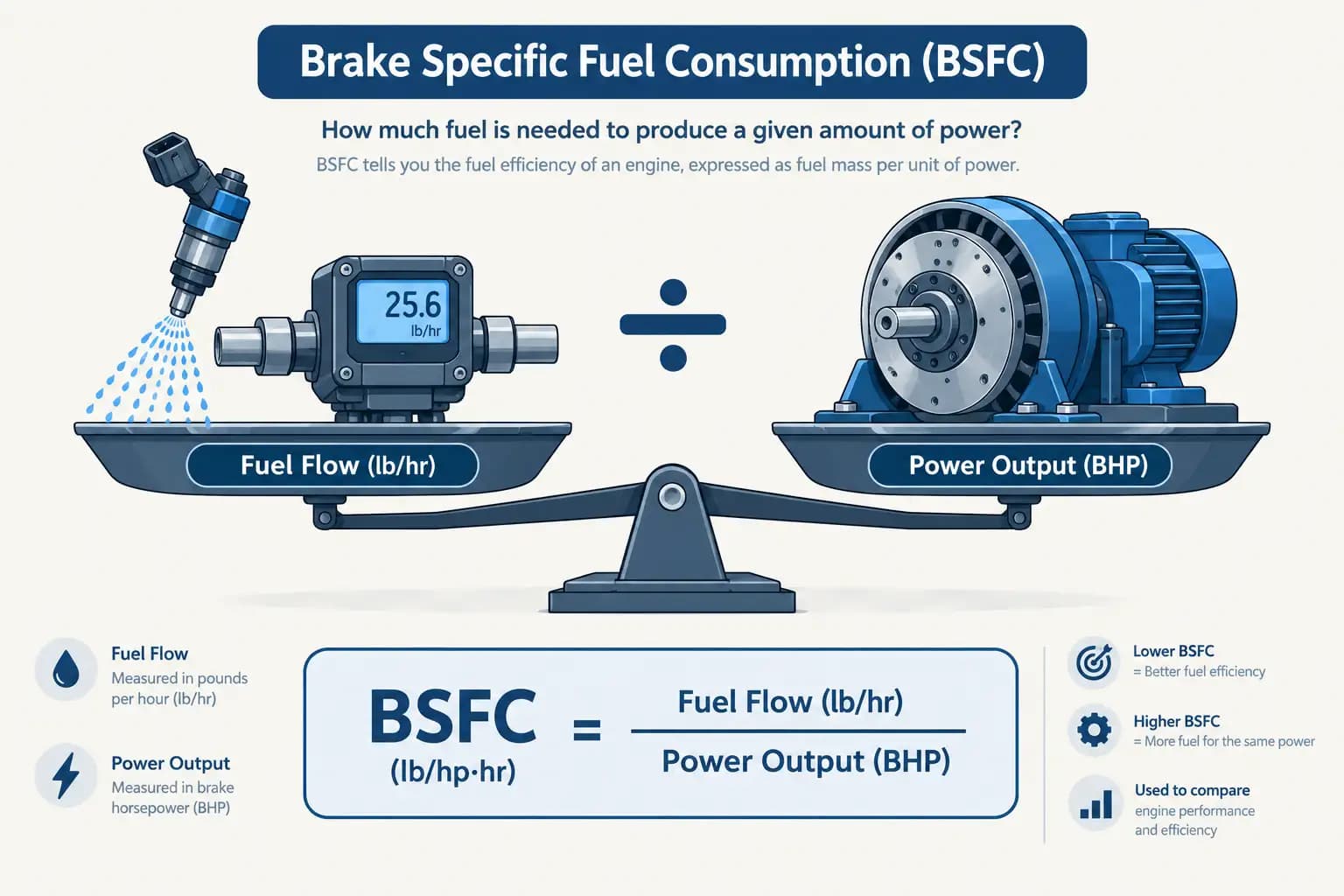
The mathematical equation for brake specific fuel consumption is straightforward:
BSFC = Fuel Flow Rate / Engine Power Output
Depending on your region and application, you will encounter two primary measurement standards:
Imperial Units (Pounds per Horsepower-Hour)
In US racing, aviation, and automotive performance, fuel flow is measured in pounds per hour (lb/hr), and power is measured in brake horsepower (hp):
BSFC (lb/(hp*hr)) = Fuel Flow (lb/hr) / Power (hp)
Metric Units (Grams per Kilowatt-Hour)
In automotive engineering standards and international applications, fuel flow is measured in grams per hour (g/h), and power is measured in kilowatts (kW):
BSFC (g/(kW*h)) = Fuel Flow (g/h) / Power (kW)
To convert between the two standards:
- 1 lb/(hphr) = 608.277 g/(kWh)
- 1 g/(kWh) = 0.001644 lb/(hphr)
If you know your engine's power and its target BSFC, you can rearrange the equation to find your total required fuel flow:
Fuel Flow (lb/hr) = Power (hp) * BSFC (lb/(hp*hr))
This rearranged formula is what tuners use when designing fuel supply lines, picking fuel pumps, and selecting fuel injectors.
Typical BSFC Values by Engine Type and Fuel
Expected BSFC values vary depending on whether an engine is naturally aspirated, supercharged, or turbocharged, as well as the fuel type. Forced induction engines run richer air-fuel mixtures and lower compression ratios to avoid knock, which increases their BSFC.
Here is a guide to typical BSFC ranges on standard pump gasoline:
| Engine Type | Aspiration | Typical BSFC (lb/(hp*hr)) | Typical BSFC (g/(kW*h)) |
|---|---|---|---|
| Modern High-Compression Race Engine | Naturally Aspirated | 0.40 to 0.45 | 243 to 274 |
| Typical Production Street Engine | Naturally Aspirated | 0.45 to 0.50 | 274 to 304 |
| Mild Supercharged / Turbocharged | Forced Induction | 0.50 to 0.55 | 304 to 335 |
| High-Boost Race Turbocharged | Forced Induction | 0.55 to 0.65 | 335 to 395 |
| Modern Direct-Injection Turbodiesel | Forced Induction | 0.30 to 0.38 | 182 to 231 |
| Rotary (Wankel) Engine | Naturally Aspirated / Turbo | 0.55 to 0.70 | 335 to 426 |
How Fuel Type Changes BSFC
Alternative fuels contain different amounts of chemical energy per pound. Because ethanol and methanol carry lower energy densities than standard gasoline, the engine must burn a higher volume of fuel to create the same mechanical force:
- Gasoline (Pump / Race Gas): Baseline energy density. Typical naturally aspirated BSFC sits around 0.45 to 0.50 lb/(hp*hr).
- E85 (85% Ethanol blend): Requires roughly 30% more fuel mass than gasoline. Expect BSFC values between 0.60 and 0.75 lb/(hp*hr).
- Methanol: Carries less than half the energy density of gasoline. Methanol drag engines run massive fuel volumes, producing BSFC numbers between 1.0 and 2.2 lb/(hp*hr).
- Diesel: Diesel fuel is dense in energy and diesel engines operate at very high compression ratios with lean combustion. Typical heavy-duty diesel engines operate at 0.32 to 0.36 lb/(hp*hr).
Worked Examples
Example 1: Finding BSFC on a Dyno
Suppose you build a naturally aspirated V8 engine. On the engine dyno, it generates 520 horsepower at 6,200 RPM. The dyno's fuel turbine measures a total fuel flow rate of 244 pounds of gasoline per hour.
- Identify inputs:
- Power = 520 hp
- Fuel Flow = 244 lb/hr
- Apply the formula:
- BSFC = 244 / 520
- Calculate:
- BSFC = 0.469 lb/(hp*hr)
Interpretation: A result of 0.469 lb/(hp*hr) is right in line with a healthy, well-tuned naturally aspirated street and strip engine. It shows clean combustion without dangerous lean conditions or wasteful over-fueling.
Example 2: Sizing Fuel Injectors Using Target BSFC
Suppose you are assembling a turbocharged 4-cylinder engine and aim to make 400 flywheel horsepower on pump gas. You want to determine how large each of your four fuel injectors must be.
- Estimate target BSFC:
- For a street turbocharged engine, a safe BSFC estimate is 0.55 lb/(hp*hr).
- Calculate total engine fuel demand:
- Total Fuel Flow = 400 hp * 0.55 lb/(hp*hr) = 220 lb/hr
- Calculate flow per cylinder (4 cylinders):
- Per-cylinder flow = 220 / 4 = 55 lb/hr
- Account for safe duty cycle (85% maximum recommended duty cycle):
- Injector Size = 55 / 0.85 = 64.7 lb/hr per injector
- Convert to cubic centimeters per minute (cc/min):
- Multiply lb/hr by 10.5: 64.7 * 10.5 = 679.4 cc/min
You would round up and install standard 700 cc/min to 750 cc/min fuel injectors.
Practical Uses for Engine Builders and Tuners
Engineers and amateur mechanics rely on BSFC calculations in three primary scenarios:
1. Fuel Pump and Line Sizing
A high-flow fuel pump must deliver enough volume to keep fuel rail pressure steady at wide-open throttle. If you calculate that your supercharged engine demands 330 pounds of fuel per hour, you can convert that mass to liquid volume. Gasoline weighs roughly 6.1 pounds per gallon, which means you need a pump capable of flowing at least 54 gallons per hour (about 205 liters per hour) at working fuel rail pressure.
2. Identifying Mechanical or Tuning Problems
If a dyno run shows an unusually high BSFC, such as 0.68 on a naturally aspirated engine, the engine is burning fuel without generating the expected power. Common culprits include:
- Retarded ignition timing
- Inefficient combustion chamber design
- Exhaust restriction or high backpressure
- Overly rich air-fuel ratios washing the cylinder walls
If the BSFC reads lower than 0.38 on a gasoline engine, the sensor readings are likely wrong, or the engine is running unsafely lean, risking piston damage.
3. Flight Range and Marine Vessel Planning
In small aircraft and marine boats, engines operate at steady cruising power settings for hours at a time. Pilots and captains calculate fuel burn rates directly from cruise BSFC numbers to determine fuel reserves and maximum range.
Interpreting Your BSFC Results
BSFC numbers change across an engine's operating rev range. A single number never describes the entire operating profile.
When you map an engine across varying RPM and load conditions, you get a contour plot called a BSFC map. The center of this map features an oval shaped area known as the fuel island, where the engine operates at its highest thermal efficiency.
High BSFC (0.60+)   --> Rich protection, high RPM, or mechanical drag
Moderate BSFC (0.48) --> Normal wide-open throttle full power
Lowest BSFC (0.42)  --> Peak volumetric efficiency, moderate load (Island)
The lowest BSFC almost always coincides with peak engine torque. At peak torque, the cylinders achieve their best cylinder filling (volumetric efficiency). As engine speeds climb toward peak horsepower, frictional losses from pistons, rings, and valvetrains rise rapidly, causing BSFC to rise again.
Common Mistakes When Calculating BSFC
Small oversights can throw off your calculations:
- Mixing Wheel Horsepower and Flywheel Horsepower: Chassis dynamometers measure wheel horsepower, which is 12% to 18% lower than engine crank horsepower due to drivetrain friction. If you divide engine fuel flow by wheel horsepower, your calculated BSFC will look artificially high and inefficient. Always use crank (brake) power for standard BSFC.
- Confusing Volume Flow with Mass Flow: Fuel pumps are often rated in liters per hour or gallons per hour (volume). BSFC requires mass flow (pounds or grams). Because fuel density expands and contracts with ambient temperature, volume changes while mass remains constant. Always convert volume to mass using fuel density at your current fuel temperature.
- Assuming Factory Injector Ratings at Higher Pressures: If you run 58 psi base fuel pressure on injectors rated at 43.5 psi, the injectors will flow more fuel than their stamped rating. Use the fuel pressure differential equation to correct your flow rates first.
- Ignoring Fuel Octane and Blend Changes: Winter-blend pump gasoline contains light additives and seasonal butane that alter density. Using generic gasoline weight constants for pure race gas or winter pump gas can skew your calculated BSFC by 3% to 5%.
Limitations of the Calculation
While brake specific fuel consumption is a staple of engine development, it has limits you should keep in mind:
- Steady-State Dependency: Standard BSFC equations assume steady-state operation on a dynamometer. Under rapid acceleration, transient fuel enrichment tables squirt extra fuel into the intake runners, distorting short-term numbers.
- No Direct Measure of Emissions: A low BSFC indicates strong thermal efficiency, but it does not tell you if the engine complies with emissions standards. An engine can produce great BSFC numbers while producing high nitrogen oxide (NOx) levels due to elevated cylinder temperatures.
- Ignores Auxiliary Parasitic Losses: If your dyno setup powers external alternators, hydraulic steering pumps, or heavy mechanical cooling fans, that power gets subtracted from your measured brake torque, skewing the result.
Frequently Asked Questions
What is a good BSFC for a street car?
For a naturally aspirated gasoline street engine, a BSFC between 0.45 and 0.50 lb/(hphr) is typical at wide-open throttle. Modern direct-injected engines can reach down to 0.42 lb/(hphr).
Why do turbocharged engines have higher BSFC numbers?
Turbocharged engines use lower static compression ratios and run richer fuel mixtures under boost to cool cylinder combustion and stop detonation. This extra fuel protects pistons and exhaust valves, which raises BSFC into the 0.55 to 0.65 range.
Does a lower BSFC always mean better fuel economy?
On a dyno, yes. A lower BSFC means the engine extracts more mechanical work from each gram of fuel. On the road, real-world fuel economy also depends on vehicle weight, gearing, aerodynamic drag, and driver habits.
What is the difference between BSFC and ISFC?
BSFC measures efficiency based on brake power delivered at the engine crankshaft. ISFC (Indicated Specific Fuel Consumption) measures the theoretical power developed inside the combustion chamber before mechanical friction and pumping losses take their share.
Can BSFC be calculated with wheel horsepower?
You can run the math, but the resulting value is usually called Wheel Specific Fuel Consumption. Because drivetrain drag consumes power through transmissions, driveshafts, and differentials, this number will be 12% to 20% higher than true engine BSFC.
Why is fuel measured in mass rather than volume?
Liquid volume changes with temperature. A gallon of warm gasoline in summer weighs less and contains less total energy than a cold gallon in winter. Measuring mass in pounds or grams guarantees accurate chemistry calculations regardless of temperature.
How do I convert BSFC from lb/(hphr) to g/(kWh)?
Multiply your value in lb/(hphr) by 608.277. For example, 0.48 lb/(hphr) multiplied by 608.277 equals 291.97 g/(kW*h).
What causes an engine's BSFC to suddenly increase?
Common causes include incorrect spark timing, clogged catalytic converters, leaking fuel injectors, slipping supercharger belts, or worn piston rings causing excessive blowby and loss of compression.