Length Converter
This length converter instantly convert any distance or dimension between metric units like meters and millimeters and imperial units like inches and feet. You simply enter a number, choose your starting unit, and pick your target unit to bypass manual long division or conversion factor tables.
All-Units Comparison Grid (Live Simultaneous Conversion)
| Unit Name | Symbol | System | Converted Value | Scientific (10ⁿ) | Action |
|---|---|---|---|---|---|
Nanometer | nm | Metric / SI | 1.0000 × 10⁹ nm | 1.0000 × 10⁹ | |
Micrometer | μm | Metric / SI | 1,000,000 μm | 1.0000 × 10⁶ | |
Millimeter | mm | Metric / SI | 1,000 mm | 1.0000 × 10³ | |
Centimeter | cm | Metric / SI | 100 cm | 1.0000 × 10² | |
Decimeter | dm | Metric / SI | 10 dm | 1.0000 × 10¹ | |
Meter Input | m | Metric / SI | 1 m | 1.0000 × 10⁰ | |
Kilometer | km | Metric / SI | 0.001 km | 1.0000 × 10⁻³ | |
Mil (thou) | mil | Imperial / US Customary | 39,370.0787 mil | 3.9370 × 10⁴ | |
Inch | in | Imperial / US Customary | 39.3701 in | 3.9370 × 10¹ | |
Foot Target | ft | Imperial / US Customary | 3.2808 ft | 3.2808 × 10⁰ | Active |
Yard | yd | Imperial / US Customary | 1.0936 yd | 1.0936 × 10⁰ | |
Mile (statute) | mi | Imperial / US Customary | 0.0006 mi | 6.2137 × 10⁻⁴ | |
Nautical Mile | nmi | Aviation & Maritime | 0.0005 nmi | 5.3996 × 10⁻⁴ |

Created by Sarah Mitchell
Last updated: October 7, 2026
How to Convert Units of Length
Converting length means multiplying or dividing a starting value by a fixed conversion factor. Because every standard measurement system links directly to the International System of Units (SI) meter, every unit has an exact mathematical relationship to every other unit.
When you convert from a larger unit to a smaller unit, you multiply. For instance, a meter contains 100 centimeters, so multiplying meters by 100 gives you centimeters. When you convert from a smaller unit to a larger unit, you divide. Converting 250 millimeters to meters means dividing 250 by 1,000, which gives 0.25 meters.
When you switch between metric and imperial systems, use the base bridge established by international agreement in 1959: exactly 1 inch equals 2.54 centimeters (or 0.0254 meters). Every imperial unit traces back to this exact number.
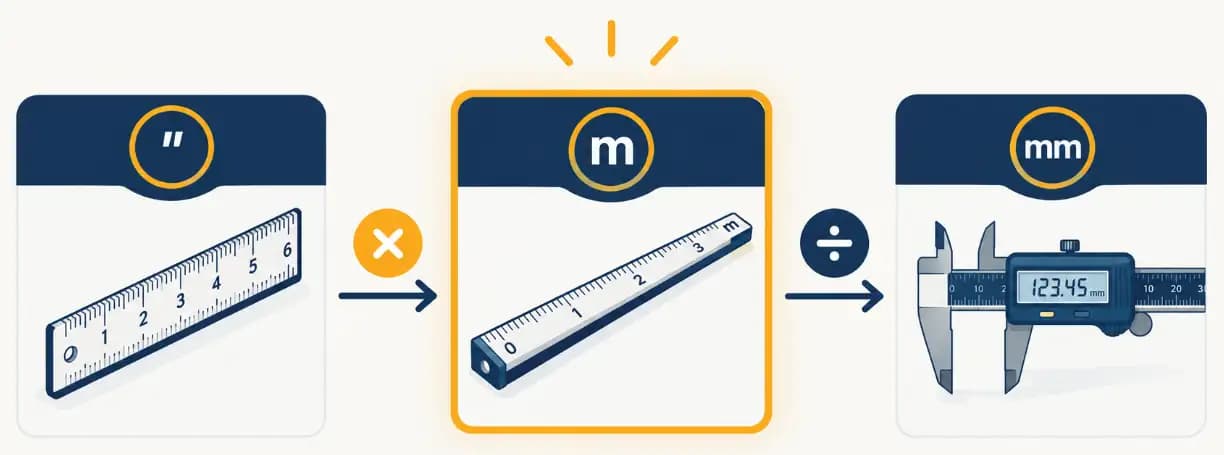
The Universal Base-Meter Method
The most reliable way to convert between two arbitrary units is to convert the starting unit to meters first, then convert meters to the final unit. This prevents you from needing hundreds of separate conversion formulas memorized.
- Multiply your initial value by the number of meters in unit A.
- Divide that intermediate value by the number of meters in unit B.
If you are calculating speed or travel times across varying distances, pairing this method with a speed distance time calculator makes planning road trips or transit logistics straightforward.
Core Length Conversion Formulas and Factors
The table below lists the exact conversion factors relative to the standard meter for common metric, imperial, and specialized units.
| Unit | Symbol | System | Value in Meters (Exact or Rounded) |
|---|---|---|---|
| Millimeter | mm | Metric | 0.001 m |
| Centimeter | cm | Metric | 0.01 m |
| Decimeter | dm | Metric | 0.1 m |
| Meter | m | Metric | 1.0 m |
| Kilometer | km | Metric | 1,000 m |
| Inch | in | Imperial / US | 0.0254 m |
| Foot | ft | Imperial / US | 0.3048 m |
| Yard | yd | Imperial / US | 0.9144 m |
| Mile | mi | Imperial / US | 1,609.344 m |
| Nautical Mile | nmi | Maritime / Aviation | 1,852 m |
| Mil (Thou) | mil | Precision Engineering | 0.0000254 m |
Quick Formula Reference
Conversion Examples
Walking through the arithmetic step by step shows how conversion factors function across systems.
Suppose you measure a piece of wood at 45 centimeters and need to cut it using an imperial tape measure marked in inches.
To find the nearest standard 16th of an inch, take the decimal portion (0.7165), multiply by 16, and round to the nearest whole integer:
The board measures approximately 17 and 11/16 inches.
Imagine you are driving abroad and see a distance marker showing an exit in 12.5 miles. You need to know the distance in kilometers on your rental car odometer.
The exit is roughly 20.1 kilometers ahead.
Architectural blueprints frequently specify heights in compound feet and inches, such as a ceiling clearance of 8 feet 6 inches. Converting this to meters requires consolidating to decimal feet or total inches first.
If you are ordering drywall or hardwood for this ceiling, enter these dimensions into a square footage calculator to find the total surface coverage before purchasing materials.
Frequently Asked Questions
Why is an inch defined as exactly 2.54 centimeters?
In 1959, the International Yard and Pound Agreement standardized the yard as exactly 0.9144 meters across English-speaking countries. Dividing 0.9144 by 36 inches yields exactly 0.0254 meters, making 1 inch equal to 2.54 cm by law.
What is the difference between a statute mile and a nautical mile?
A statute mile measures 5,280 feet (1,609.344 meters) and serves as the standard road measurement on land. A nautical mile measures exactly 1,852 meters (approximately 6,076.12 feet) and equals one minute of latitude along the Earth's meridian.
How do I convert decimal feet to feet and inches?
Keep the whole number as the feet, then multiply the remaining decimal portion by 12 to get inches. For example, 6.75 feet has 6 feet, plus 0.75 × 12 = 9 inches, giving 6 feet 9 inches.
Can length values be negative?
Geometric lengths and physical distances cannot be negative because distance represents physical separation. In vector physics or coordinate geometry, negative signs indicate direction along an axis rather than negative physical length.
How many centimeters are in a foot?
There are exactly 30.48 centimeters in one foot. This figure comes from multiplying 12 inches by 2.54 centimeters per inch (12 × 2.54 = 30.48).
Why does dividing by 0.3048 convert meters back to feet?
Because 1 foot equals 0.3048 meters, dividing your meter total by 0.3048 reverses the multiplication and gives the equivalent quantity in feet.
What is the easiest way to estimate meters to feet in your head?
Multiply the number of meters by 3, then add 10% of that product. For example, for 5 meters: 5 × 3 = 15, and 15 + 1.5 = 16.5 feet. The exact number is 16.404 feet, making this mental estimate accurate within half an inch.