Boat Speed Calculator
This boat speed calculator estimates your vessel's top speed and propeller slip using engine RPM, gearcase ratio, and propeller pitch. It eliminates trial-and-error when repropping your boat, helping you spot lost speed and engine drag before buying expensive new hardware. Use it to check if your outboard, sterndrive, or inboard powertrain delivers peak efficiency on the water.
The default for most production boats
| Hull type | Constant | Notes |
|---|---|---|
| 150 | The default for most production boats | |
| 190 | Lighter build, more efficient running surface | |
| 210 | Purpose-built hulls with minimal wetted area | |
| 220 | Rides on three small points at speed | |
| 230 | The most efficient planing form |

Created by Liam Fletcher
Last updated: September 25, 2026
How to Calculate Boat Speed
Calculating your theoretical boat speed involves measuring how far your propeller advances through the water with every full turn of the propeller shaft. If water were a solid block of wood, a propeller would bite into it and move forward by its exact rated pitch with each complete revolution. Because water is a liquid, propellers experience a loss of forward travel known as propeller slip.
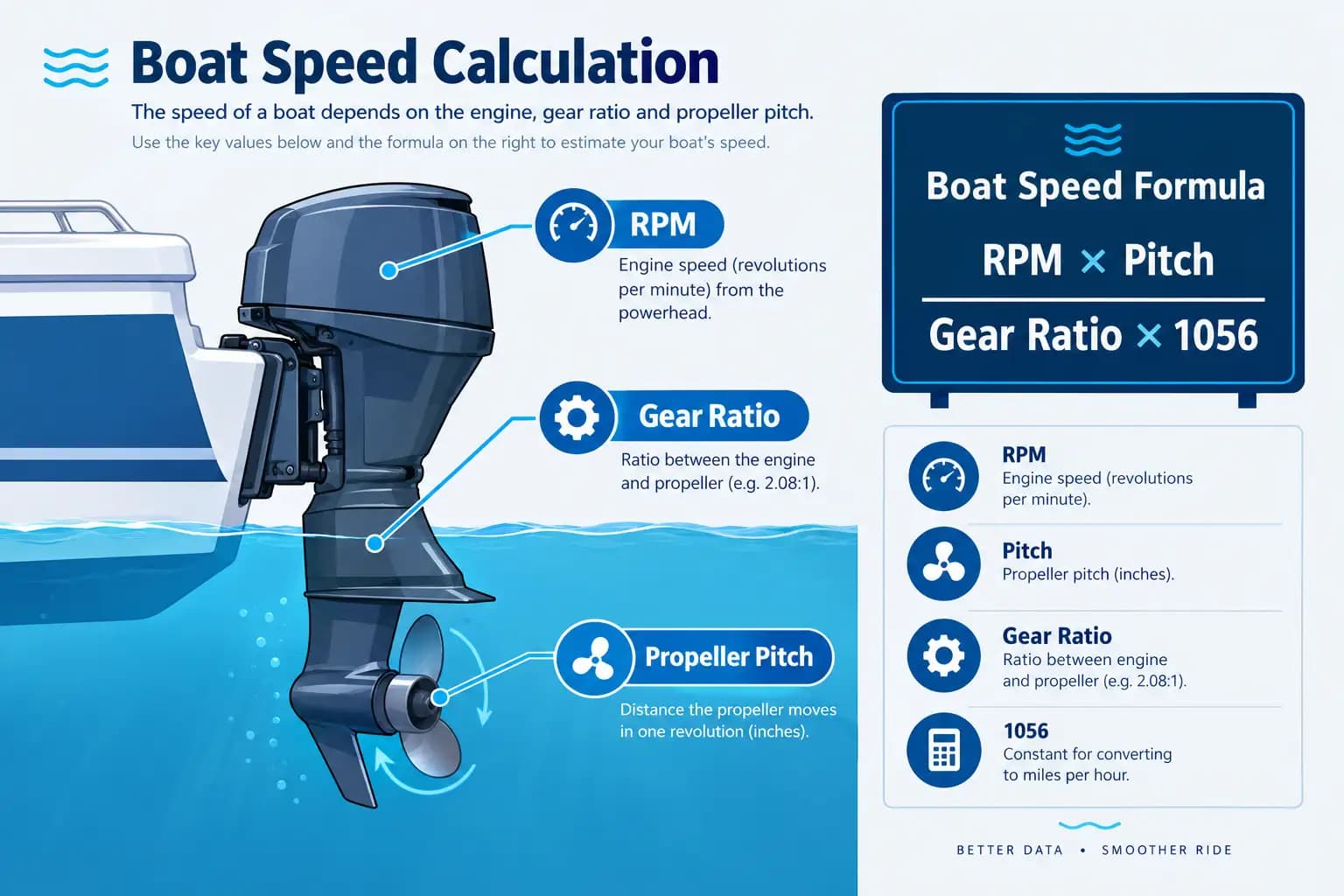
To calculate expected boat speed in statute miles per hour (MPH), use this primary marine formula:
Once you have the theoretical speed, factor in your propeller slip percentage:
If you prefer your speed in nautical miles per hour (knots), divide your calculated MPH by 1.15078, or adjust the mathematical constant in the denominator from 1056 to 1215.2.
Here is what each component in this formula represents:
- Engine RPM: The current speed of your engine crankshaft in revolutions per minute, visible on your tachometer.
- Propeller Pitch: The theoretical forward distance, measured in inches, that your propeller moves during one single 360-degree rotation.
- Gear Ratio: The mechanical reduction inside your lower unit gearcase. It compares drive-shaft rotations to prop-shaft rotations (such as 1.85:1 or 2.00:1).
- 1056 (Constant): A conversion factor that cancels out inches into miles (63,360 inches per mile) and minutes into hours (60 minutes per hour). 63,360 divided by 60 equals 1056.
- Propeller Slip: The percentage of efficiency lost due to blade friction, drag, and water displacement.
Understanding Propeller Slip
Propeller slip causes confusion for many boat owners. Slip is not a mechanical defect or a sign that your propeller is spinning loose on its rubber hub. Slip is simply the difference between theoretical pitch distance and actual forward movement through water.
Every marine propeller requires an angle of attack to generate forward thrust, much like an airplane wing needs an angle of attack to generate lift. Without slip, water would not flow across the curved blade surfaces, and your boat would not produce dynamic push.
Typical slip values vary by boat design and hull load:
- High-Performance Bass Boats and Racing Hulls: 6% to 10% slip at wide-open throttle (WOT).
- Standard Runabouts, Bowriders, and Deck Boats: 10% to 15% slip under normal cruising loads.
- Offshore Center Consoles and Multi-Engine Hulls: 12% to 18% slip due to deep draft and heavier gear displacement.
- Pontoon Boats and Heavy Cabin Cruisers: 18% to 25% slip because of flat surfaces and substantial hydrodynamic drag.
- Tow-Sports Boats (Wakeboarding and Surfing): 20% to 30% slip when ballast tanks are full and hulls operate at heavy plowing angles.
If your slip calculation exceeds 25% on a standard planing monohull, your setup needs attention. Excessive slip usually points to an engine mounted too high on the transom, worn propeller blade cupping, incorrect trim angles, or an engine struggling to reach its designed power band.
Step-by-Step Worked Examples
Working through the math by hand shows how these mechanical values interact before you test new hardware on the water.
Example 1: Finding Top Speed on a Sport Runabout
Suppose you own an 18-foot bowrider powered by a 150-horsepower outboard. You want to estimate your expected top speed at wide-open throttle:
- Engine RPM: 5,800 RPM
- Gear Ratio: 2.00:1 (enter 2.00 into the formula)
- Propeller Pitch: 19 inches
- Expected Propeller Slip: 12%
First, calculate theoretical speed:
Next, apply your estimated 12% slip:
In knots, that equals:
Your boat will cruise flat-out at roughly 46 MPH (40 knots) on flat water.
Example 2: Calculating Exact Propeller Slip from GPS Speed
Suppose you run your boat wide-open and your GPS speedometer reads 42.5 MPH, but you want to check if your propeller is operating efficiently. Your engine runs at 5,500 RPM with a 1.85:1 gearcase ratio and a 17-inch pitch prop.
First, determine theoretical speed:
Next, calculate your true slip percentage using this formula:
A slip value of 11.2% is healthy for an aluminum or light stainless-steel propeller on a recreation hull.
Hull Speed vs. Planing Speed
Boats move through water in two main operating modes: displacement mode and planing mode. Knowing which category your boat belongs to is critical, because it decides which tab you want. The Power and Propeller tabs both assume a hull that can climb on top of the water, while the Hull speed tab covers displacement hulls that cannot.
Theoretical Displacement Hull Speed
Displacement hulls (including sailboats, trawlers, and heavy tugs) do not climb on top of their bow wake. Instead, they push water aside and travel within a wave trough formed by their own motion. As a displacement boat speeds up, its bow wave and stern wave move farther apart. Eventually, the wavelength equals the boat's waterline length.
At that point, the boat becomes trapped in its own trough. Adding massive engine power only buries the stern deeper without creating meaningful speed gains. Naval architects calculate maximum displacement speed using this formula:
For a cruiser with a 36-foot waterline length:
No matter how large an engine you install, a pure displacement hull will level off near this ceiling.
Planing Hulls
Planing hulls (including runabouts, center consoles, skiffs, and cruisers) break free from wave traps. When given enough horsepower, dynamic lift forces the forward hull upward until the boat skims along the surface.
Once on plane, your boat overcomes standard displacement barriers. Planing speeds depend almost entirely on power-to-weight ratio, lower-unit gearing, propeller selection, and running trim.
How Propeller Pitch and Gear Ratios Affect Speed
Selecting the correct propeller requires balancing pitch, blade geometry, and lower unit gear reduction.
The Role of Propeller Pitch
Pitch measures theoretical advance per revolution. Think of pitch like bicycle gearing:
- Lower Pitch (13" to 17"): Acts like low gear on a bicycle. The engine revs up quickly, giving you excellent out-of-the-hole acceleration for pulling skiers or popping a heavily loaded boat on plane. Your top-end speed drops, and you risk over-revving your motor past its recommended wide-open throttle operating limit.
- Higher Pitch (21" to 25"): Acts like high gear on a ten-speed bike. It yields higher cruising and top-end speeds at lower engine RPM, but hurts low-speed acceleration. If the pitch is too steep, the motor lugs, struggles to plane, and builds up internal cylinder heat.
A general rule of thumb across marine engines states that a 2-inch change in prop pitch changes full-throttle engine speed by roughly 300 to 400 RPM. Decreasing pitch increases engine RPM, while increasing pitch pulls RPM down.
Lower Unit Gear Ratios
Your outboard or sterndrive contains reduction gears inside the lower gearcase torpedo. Common gear ratios include 1.75:1, 1.85:1, 2.00:1, and 2.33:1.
A 2.00:1 ratio means the motor crankshaft turns two full times to turn the propeller shaft once. Manufacturers pair heavier boats with higher numerical gear ratios (like 2.33:1) to swing wider-diameter propellers that push heavy loads without overworking internal cylinders. High-speed performance boats rely on lower numerical ratios (like 1.62:1 or 1.75:1) to spin the prop shaft faster for higher top speeds.
Environmental and Loading Factors That Change Boat Speed
Calculators provide exact mathematical answers, but natural waterways introduce variables that alter your digital speedometer readouts:
- Currents and Tides: Running against a 3-knot river current lowers your GPS speed over ground by 3 knots, even if your speedometer pitot tube registers full cruising velocity through the water.
- Wind Resistance and Chop: High winds turn square boat profiles into large sails. Light surface chop often improves top-end speed on planing hulls by aerating the hull bottom and reducing wetted surface friction. Heavy ocean swells, by comparison, force you to back off throttle to prevent hull slamming.
- Fuel and Gear Weight: Marine gasoline weighs roughly 6.1 pounds per gallon, while fresh water weighs 8.34 pounds per gallon. Filling a 100-gallon fuel tank and a 30-gallon freshwater washdown tank adds over 850 pounds of deadweight. That extra mass drags the hull deeper, widening wetted surface area and increasing slip by 3% to 6%.
- Water Temperature and Density: Cold salt water is denser than warm fresh water. Saltwater hulls ride higher on the surface, which drops friction and can pick up 1 to 2 MPH over warm freshwater lake testing.
- Marine Growth and Hull Fouling: Leaving your boat in a wet slip creates algae and barnacle buildup. Even a light layer of marine slime on a gelcoat bottom can scrub 4 to 8 MPH off your normal top speed by destroying smooth laminar water flow.
Common Mistakes When Calculating Boat Speed
Small measurement mistakes cause large calculation errors. Avoid these common missteps:
- Confusing Knots and Statute MPH: Knots and miles per hour are not identical. One knot equals 1.15078 statute miles per hour. Reading an analog dashboard gauge set to knots while entering values into an MPH formula creates a 15% error in your calculated slip.
- Reading Speedometer Tubes Instead of GPS: Transom pitot tubes and paddle-wheel speed sensors clog easily with lake weed and sand. They routinely read 3 to 6 MPH off true speed. Always use a clear GPS satellite reading over flat, slack water when measuring real boat velocity.
- Using Estimated RPM Instead of Engine Diagnostics: Analog dashboard tachometers often lose calibration over time, straying off by 200 to 500 RPM. Connect a digital NMEA 2000 engine display or diagnostic scan tool to get accurate crankshaft readings before making expensive propeller changes.
- Entering an Incorrect Gear Ratio: Outboard manufacturers often use different gearcase ratios across standard models and high-output counter-rotation variants of the same horsepower rating. Verify your lower unit's exact mechanical ratio on the manufacturer specification plate rather than guessing.
- Ignoring Hull Trim Angle: Trimming your outboard or sterndrive tucked all the way down pushes the bow into the water, creating excessive plowing friction and false high slip numbers. Trim your engine upward until the hull feels light and steering wheel torque neutralizes before logging your benchmark top speed.
Practical Tips for Improving Boat Speed and Efficiency
If your calculation reveals high propeller slip or lower speeds than expected, simple mechanical adjustments can restore your vessel's performance:
- Upgrade from Aluminum to Stainless Steel: Aluminum blades flex under high acceleration and heavy engine loads, which bleeds off pitch. Stainless steel blades are four times stiffer, allowing thinner blade profiles and more aggressive cupping that holds water firmly without flexing.
- Dial in Engine Mounting Height: If your anti-ventilation plate sits submerged below the water stream while planing at cruise speed, your lower unit creates parasitic drag. Raising the outboard on your transom bolt holes can unlock 1 to 3 MPH, provided your cooling water intake remains safely submerged.
- Experiment with Blade Cupping: Adding a slight curved cup to the trailing edge of your propeller blades acts like extra pitch. Cupping grabs clean water, reduces blow-out in sharp turns, and lets you trim higher without ventilating the blades.
- Balance Onboard Weight Distribution: Shifting heavy battery banks, spare anchors, and coolers toward the rear of a planing hull lifts the bow naturally. This balances running attitude, sheds hull drag, and helps your propeller maintain forward bite.
Frequently Asked Questions
What is a good propeller slip percentage for a recreational boat?
A slip percentage between 10% and 15% is standard for most recreational runabouts, deck boats, and bowriders at wide-open throttle. High-performance hulls can see slip drop down to 7%, while pontoon boats and heavily loaded cruisers often sit between 18% and 24%.
Can propeller slip ever be negative?
No, a propeller cannot produce true negative slip in water. If your calculations return a negative slip number, your propeller either has aggressive aftermarket cupping (making its effective pitch higher than stamped), your tachometer is reading low, or your lower unit gear ratio is incorrect.
How does changing prop pitch affect my engine RPM?
Increasing your propeller pitch by 2 inches will typically lower your wide-open throttle engine speed by 300 to 400 RPM. Conversely, dropping down 2 inches in pitch will increase your engine speed by roughly the same amount.
Why is my GPS speed slower than my speedometer reading?
Mechanical water pick-up speedometers rely on water pressure and easily register false high readings from turbulence under the transom. GPS measures your true speed over ground via satellite positioning, making it far more reliable for performance testing.
What is the difference between knots and miles per hour?
One knot equals one nautical mile per hour, which is exactly 1.15078 statute miles per hour. Knots are based on one minute of latitude along the Earth's surface, making them standard for marine navigation.
How do I find my boat's lower unit gear ratio?
Look up the exact engine model number on your outboard or sterndrive manufacturer plate. Your owner's manual lists the gear ratio in the specifications table, usually noted as a value like 1.85:1, 2.00:1, or 2.15:1.
Does a four-blade propeller make a boat faster than a three-blade propeller?
Usually, no. Three-blade propellers produce less drag in the water and almost always deliver higher top-end speeds. Four-blade propellers provide better low-speed planing, improved rough-water bite, and stronger midrange cruising hold at the expense of 1 to 2 MPH at wide-open throttle.
Can I calculate boat speed if I only know engine horsepower?
You can roughly estimate potential speed using Crouch's formula based on horsepower, total displacement weight, and hull type constants. However, calculating mechanical boat speed using RPM, gear ratio, and prop pitch provides far more reliable accuracy for propeller tuning.