Jacket Size Calculator
This jacket size calculator converts your body measurements into your exact jacket size across US, UK, and European standards. Enter your chest circumference, height, and preferred fit style to find the right tag size and jacket length instantly. It eliminates sizing confusion across suit jackets, blazers, and outerwear.
Structured, worn over a shirt
The standard off-the-rack cut, room for a shirt and light knit. Adds 1.5 in of ease.
The same size elsewhere
Italian jackets use the EU number. UK and US share the same chest-based numbering.
These are typical finished measurements for the size. Every brand drafts slightly differently, so treat them as a check against a garment you are about to buy rather than a guarantee.
| Chest | US | UK | EU | Alpha |
|---|---|---|---|---|
| 33-35 in | 34 | 34 | 44 | S |
| 35-37 in | 36 | 36 | 46 | S |
| 37-39 in | 38 | 38 | 48 | M |
| 39-41 in | 40 | 40 | 50 | M |
| 41-43 in | 42 | 42 | 52 | L |
| 43-45 in | 44 | 44 | 54 | L |
| 45-47 in | 46 | 46 | 56 | XL |
| 47-49 in | 48 | 48 | 58 | XL |
| 49-51 in | 50 | 50 | 60 | XXL |
| 51-53 in | 52 | 52 | 62 | XXL |
| 53-55 in | 54 | 54 | 64 | 3XL |
| 55-57 in | 56 | 56 | 66 | 3XL |

Created by Jordan Clarke
Last updated: September 21, 2026
How to Find Your Jacket Size
This jacket size calculator converts your body measurements into your exact jacket size across US, UK, and European standards. Enter your chest circumference, height, and preferred fit style to find the right tag size and jacket length instantly. It eliminates sizing confusion across suit jackets, blazers, and outerwear.
Jacket sizing starts with a single anchor measurement: your chest circumference. Tailoring traditions across the globe rely on chest width because a jacket must drape cleanly across your torso without pulling at the buttons or bunching behind the shoulder blades.
For men, US and UK jacket sizes match the chest measurement directly in inches. If your chest measures 40 inches around, your base jacket size is 40. European sizing uses centimeters and adds an offset. A US 40 translates to an EU 50, which equals half your chest circumference in centimeters plus an allowance, or simply your US size plus 10.
For women, jacket sizing combines chest or bust measurements with waist and shoulder width. Sizing charts typically map chest measurements to standard numerical dress sizes (such as US 6 or EU 38) or letter grades from XS through XXL.
Length matters just as much as chest width. Two people with a 42-inch chest will need completely different garments if one stands 5 feet 7 inches tall and the other stands 6 feet 2 inches tall. Jacket makers handle this by pairing chest numbers with length letters:
- Short (S): Designed for heights 5 feet 7 inches (170 cm) and under. Sleeves and jacket hemlines are cut roughly 1 to 1.5 inches shorter than standard cuts.
- Regular (R): Tailored for heights between 5 feet 8 inches and 5 feet 11 inches (173 cm to 180 cm). This is the default off-the-rack proportion.
- Long (L): Cut for individuals 6 feet 0 inches to 6 feet 3 inches (183 cm to 190 cm). The torso drop and sleeves are extended by roughly 1.5 inches.
- Extra Long (XL): Best for people 6 feet 4 inches (193 cm) and taller.
How to Measure Yourself for a Jacket
Accurate sizing requires consistent tape measurements. Use a flexible fabric measuring tape. Keep the tape level across your body, parallel to the floor, without pulling it tight enough to compress your skin.
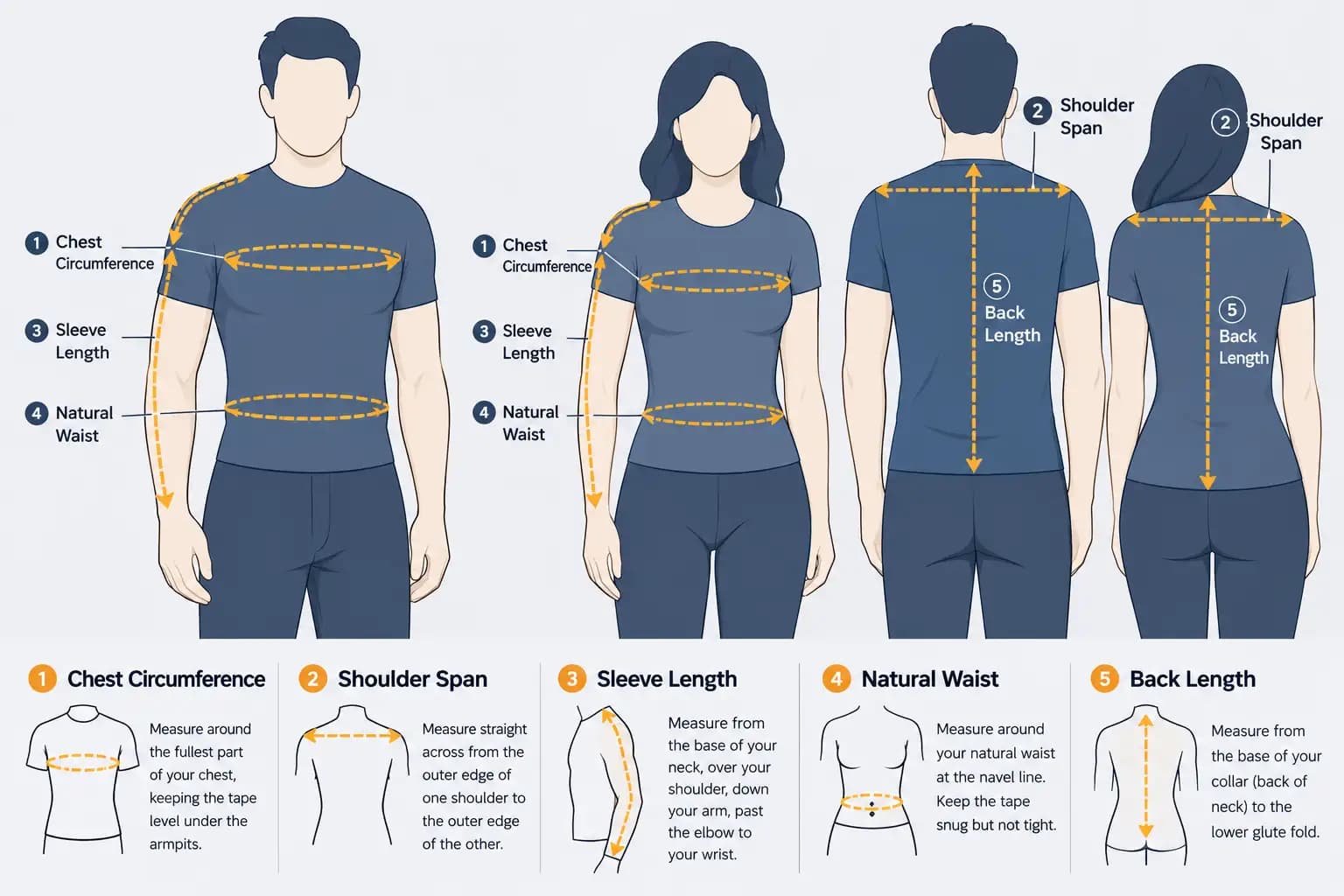
1. Chest Circumference (Primary Measurement)
Stand upright and relax your arms at your sides. Wrap the measuring tape around the fullest part of your chest, passing directly under your armpits and across your shoulder blades. Breathe normally. Do not puff out your chest or suck in your stomach. Keep one finger between the tape and your body to leave room for natural movement.
2. Overarm or Shoulder Span
Stand straight and measure horizontally across the widest point of your shoulders, from the bony tip of one shoulder blade across your upper back to the opposite tip. For an overarm measurement, wrap the tape completely around the outside of both arms at the widest point of your chest. Subtract 6 to 7 inches from your overarm measurement to verify your chest size if you have broad, muscular shoulders.
3. Sleeve Length
Place one hand on your hip with your elbow bent at a 90-degree angle. Have a friend measure from the prominent bone at the base of your neck, across the shoulder point, down along the outside of your arm, past the elbow, down to your wrist bone. If measuring along an existing jacket that fits you well, measure straight from the shoulder seam down to the sleeve cuff edge.
4. Natural Waist and Stomach
Measure around your torso at the midpoint between your lowest rib and the top of your hip bone, usually right across your belly button. Suit jackets feature a natural "drop," which is the difference between the jacket chest size and the trouser waist size. Knowing your stomach width prevents buying a jacket that fastens too tightly around the midsection.
5. Jacket Back Length
Measure vertically down your back from the base of your collar seam down to the point where your buttocks meet your upper thigh. A classic jacket hemline should hit right at the thumb knuckle when your arms hang relaxed at your sides.
Sizing Formulas and Conversions
Garment makers follow standard mathematical rules when grading patterns. You can calculate your base jacket size manually using simple conversions.
US and UK Men's Sizing
Your tag size equals your bare chest circumference in inches rounded up to the nearest even whole number:
Where fit ease is:
- Slim Fit: Add 0 to 1 inch of ease. A 39.5-inch chest wears a size 40.
- Classic / Regular Fit: Add 1 to 2 inches of ease. A 40-inch chest wears a size 41 or 42.
- Relaxed / Outerwear Fit: Add 2 to 3 inches of ease, especially if wearing heavy sweaters beneath the jacket.
European (EU) Men's Sizing
European sizing uses centimeters. To convert from inches to European sizes:
Or, calculated directly in centimeters:
If your chest circumference is 100 cm, your European size is 50. Because 100 cm equals roughly 39.4 inches (rounded to size 40 in the US), adding 10 to a US 40 gives you an EU 50.
The Tailoring "Drop" Ratio
Suit jackets are built around a standard drop calculation:
- Drop 6 (Standard): The baseline cut for most off-the-rack suits. A size 40 regular jacket comes paired with size 34 pants.
- Drop 7 or 8 (Athletic / Slim): Tailored for broader chests with narrow waists. A size 40 jacket pairs with a 32 or 33-inch waist.
- Drop 4 (Portly / Relaxed): Built for fuller midsections, pairing a size 40 jacket with 36-inch pants.
Men's Jacket Size Conversion Table
| US / UK Size | EU Size | Chest (Inches) | Chest (cm) | Alpha Size | Recommended Height Bracket |
|---|---|---|---|---|---|
| 34 | 44 | 33" to 34.5" | 84 to 88 cm | XS | S: under 5'7" | R: 5'8"-5'11" |
| 36 | 46 | 35" to 36.5" | 89 to 93 cm | S | S: under 5'7" | R: 5'8"-5'11" |
| 38 | 48 | 37" to 38.5" | 94 to 98 cm | M | S: under 5'7" | R: 5'8"-5'11" | L: 6'0"+ |
| 40 | 50 | 39" to 40.5" | 99 to 103 cm | M / L | S: under 5'7" | R: 5'8"-5'11" | L: 6'0"+ |
| 42 | 52 | 41" to 42.5" | 104 to 108 cm | L | S: under 5'7" | R: 5'8"-5'11" | L: 6'0"+ |
| 44 | 54 | 43" to 44.5" | 109 to 113 cm | XL | R: 5'8"-5'11" | L: 6'0"+ | XL: 6'4"+ |
| 46 | 56 | 45" to 46.5" | 114 to 118 cm | XL / XXL | R: 5'8"-5'11" | L: 6'0"+ | XL: 6'4"+ |
| 48 | 58 | 47" to 48.5" | 119 to 123 cm | XXL | R: 5'8"-5'11" | L: 6'0"+ | XL: 6'4"+ |
| 50 | 60 | 49" to 50.5" | 124 to 128 cm | 3XL | R: 5'8"-5'11" | L: 6'0"+ | XL: 6'4"+ |
Women's Jacket Size Conversion Table
| US Size | UK Size | EU Size | Bust (Inches) | Bust (cm) | Natural Waist (Inches) | Alpha Size |
|---|---|---|---|---|---|---|
| 2 | 6 | 34 | 31.5" to 32.5" | 80 to 83 cm | 24" to 25" | XS |
| 4 | 8 | 36 | 33" to 34" | 84 to 87 cm | 26" to 27" | S |
| 6 | 10 | 38 | 34.5" to 35.5" | 88 to 91 cm | 27.5" to 28.5" | S / M |
| 8 | 12 | 40 | 36" to 37.5" | 92 to 95 cm | 29" to 30.5" | M |
| 10 | 14 | 42 | 38" to 39.5" | 96 to 100 cm | 31" to 32.5" | L |
| 12 | 16 | 44 | 40" to 41.5" | 101 to 105 cm | 33" to 34.5" | L / XL |
| 14 | 18 | 46 | 42" to 43.5" | 106 to 111 cm | 35" to 37" | XL |
| 16 | 20 | 48 | 44" to 46" | 112 to 117 cm | 37.5" to 39.5" | XXL |
Worked Sizing Examples
Example 1: Men's Tailored Suit Jacket
- Person: Michael
- Chest Measurement: 41.2 inches
- Height: 6 feet 1 inch (185 cm)
- Intended Cut: Classic Tailored Fit
- Calculate Chest Base: Michael's chest measures 41.2 inches. Rounding up to allow clean movement gives 42 inches.
- Determine Fit Ease: A tailored fit requires 1 inch of ease over the natural chest. 41.2 plus 1.0 equals 42.2 inches. Because off-the-rack men's jackets come in even numbered sizes, we select 42.
- Determine Length Cut: Michael is 6 feet 1 inch tall. Heights between 6 feet 0 inches and 6 feet 3 inches take a Long cut.
- Final Sizes:
- US / UK Size: 42L
- European Size: 42 + 10 = 52L
- Result: Michael selects a 42 Long (US/UK) or 52 Long (EU).
Example 2: Metric Outerwear Bomber Jacket
- Person: Lukas
- Chest Measurement: 96 cm
- Height: 172 cm (5 feet 7.5 inches)
- Intended Cut: Relaxed Outerwear Layer
- Calculate Base Size in cm: Half of Lukas's chest measurement is 96 / 2 = 48.
- Add Layering Ease: Lukas wants to wear a knit sweater underneath this casual bomber. Adding 4 cm to the chest measurement (100 cm total) brings the half-chest calculation to 100 / 2 = 50.
- Determine Length Cut: At 172 cm tall, Lukas falls into the Short category (under 173 cm).
- Final Sizes:
- EU Size: 50 Short (or regular Medium in casual alpha sizing)
- US / UK Size: 50 - 10 = 40 Short
- Result: Lukas orders a Size 50 Short or US 40S.
Fit Styles Explained: Slim, Regular, and Relaxed
Understanding how clothing brands label fit profiles ensures your jacket moves comfortably with your lifestyle.
   SLIM FIT          REGULAR FIT           RELAXED FIT
  .--------.        .----------.         .------------.
 / Narrow   \      / Standard   \       /  Generous    \
| Armholes   |    | Armholes     |     | Armholes       |
| Tapered    |    | Gentle Taper |     | Straight Cut   |
 \ Torso    /      \ Torso      /       \ Torso        /
  '--------'        '----------'         '------------'
  Minimal Ease       1.5"-2" Ease         3"+ Ease
  Tapered Waist      Balanced Draping     Layering Room
Slim Fit
A slim fit cut sits tight across the torso. It features high armholes, a tapered waist, and narrow sleeves. The jacket chest measures only 1 to 2 inches larger than your physical chest measurement. This style flatters slender, lean frames. If you have broad shoulders or an athletic back, an off-the-rack slim fit will often pinch across the shoulder blades.
Regular (Classic) Fit
A regular fit balances sharp tailoring with full range of motion. The chest profile carries roughly 2 to 3 inches of fabric allowance over your bare chest measurement. Armholes sit lower, giving you room to drive, sit, or reach forward without pulling the button stance open. It suits most body shapes and works across professional business settings.
Relaxed (Loose) Fit
Relaxed cuts feature straight side seams that drop straight down from the underarms without tapering at the waist. Fabric allowance runs 3 to 5 inches larger than the wearer's chest. This cut is common in heavy wool overcoats, chore coats, leather motorcycle jackets, and casual utility wear intended to layer over thick garments.
Common Jacket Sizing Mistakes
- Measuring Over Thick Clothing: Measuring your chest while wearing a heavy sweater or hoodie adds 1 to 2 inches of false measurement. Take your measurements over a bare chest or a light dress shirt.
- Ignoring the Shoulder Seam: The chest can be altered inward or outward by a tailor, but adjusting the shoulder seam requires rebuilding the entire garment. If the shoulder seam hangs off the edge of your bone or bites into your neck, the jacket does not fit.
- Confusing Total Height with Torso Length: Height brackets serve as a general guide, but leg-to-torso ratios vary. Someone with long legs and a short torso may need a Short jacket even if they stand 5 feet 9 inches tall.
- Sucking in the Stomach: Pulling your stomach inward while running the tape produces a waist measurement you cannot maintain while sitting down. Relax your posture completely.
- Overlooking Button Stance: When you fasten the top button of a two-button jacket, the fabric should rest flat against your stomach. If the lapels bow outward or the fabric pulls into an "X" shape across your torso, the jacket is at least one size too small.
How to Adjust Between Different Jacket Types
Not every jacket follows the same sizing rules. Outerwear, blazers, and casual jackets serve different functions and need different internal space.
Suit Jackets and Blazers
Suit jackets and blazers require the most precise fit. They feature structured canvas, shoulder padding, and silk linings designed to mirror your body contours. Stay true to your calculated chest size.
Winter Coats and Overcoats
Most overcoat manufacturers factor layering into their patterns automatically. A size 40 trench coat or wool overcoat is cut wider than a size 40 suit jacket so it fits neatly over a suit. Buy your normal suit jacket size unless the manufacturer explicitly notes that the garment runs true to bare body measurements.
Casual Jackets and Leather Wear
Leather jackets, denim jackets, and bombers frequently use lettered alpha sizing (S, M, L, XL). Leather stretches slightly over time across high-stress points, so a snug fit initially will yield a custom shape as the leather breaks in. For denim and canvas chore jackets, size up if you plan to wear hoodies underneath.
Frequently Asked Questions
What size jacket is a 40-inch chest?
A 40-inch chest corresponds to a size 40 in US and UK sizing, and a size 50 in European sizing. Depending on your height, you would order a 40 Short, 40 Regular, or 40 Long.
What is the difference between size 40R and 40L?
Both sizes have the same 40-inch chest circumference, but a 40L (Long) is roughly 1.5 inches longer in the sleeves and 1.5 inches longer down the back of the torso than a 40R (Regular).
How do I convert men's jacket sizes to women's sizes?
Subtract roughly 30 to 32 from a men's US jacket size to find the women's dress equivalent. A men's size 38 regular roughly corresponds to a women's size 8 or 10, though men's cuts are wider in the shoulders and straight through the hips.
What does jacket drop mean?
Drop is the difference in inches between the jacket's chest size and the matching trouser waist size. A standard suit drop is 6 inches, meaning a size 42 jacket comes paired with 36-inch waist trousers.
Should I size up if I fall between two jacket sizes?
Size up to the larger size if your measurements fall between numbers. A tailor can easily take in excess fabric through the back seam and waist, but letting out a tight jacket is limited by the internal seam allowances.
How should a jacket fit around the shoulders?
The shoulder seam should end squarely where your shoulder bone meets your upper arm. The fabric should drape flat without dimpling inward or bulging past the shoulder line.
How long should jacket sleeves be?
Jacket sleeves should end right at the base of your wrist bone, allowing roughly a quarter to half an inch of your dress shirt cuff to show past the jacket cuff.
What size jacket is an XL?
In men's clothing, an XL typically corresponds to a US/UK chest size of 44 to 46 inches, or an EU size 54 to 56. In women's jackets, an XL generally corresponds to a US dress size 14 to 16.