Midpoint Calculator
This midpoint calculator finds the halfway point between two points using their coordinate values. It helps you avoid manual calculations when finding midpoints, distances, or missing endpoints in coordinate geometry. Enter the coordinates of the points to get clear results for your calculation.
Plot
Step by step
- 1Midpoint formula
- 2Substitute the x values
- 3Substitute the y values
- 4Distance between the endpoints

Created by Jose Smith
Last updated: September 28, 2026
How to Find the Midpoint Between Two Points
A midpoint is the exact center of a line segment connecting two distinct points. It splits the total segment into two equal halves.
To find that center point, calculate the arithmetic mean of each coordinate component separately. Add the horizontal values together and divide by two. Then add the vertical values together and divide by two. If you work in three dimensions, do the same addition and division for the depth values.
This mathematical operation takes the average of the coordinates. The resulting point sits directly on the segment joining the two endpoints, precisely equidistant from both ends.
The Midpoint Formula
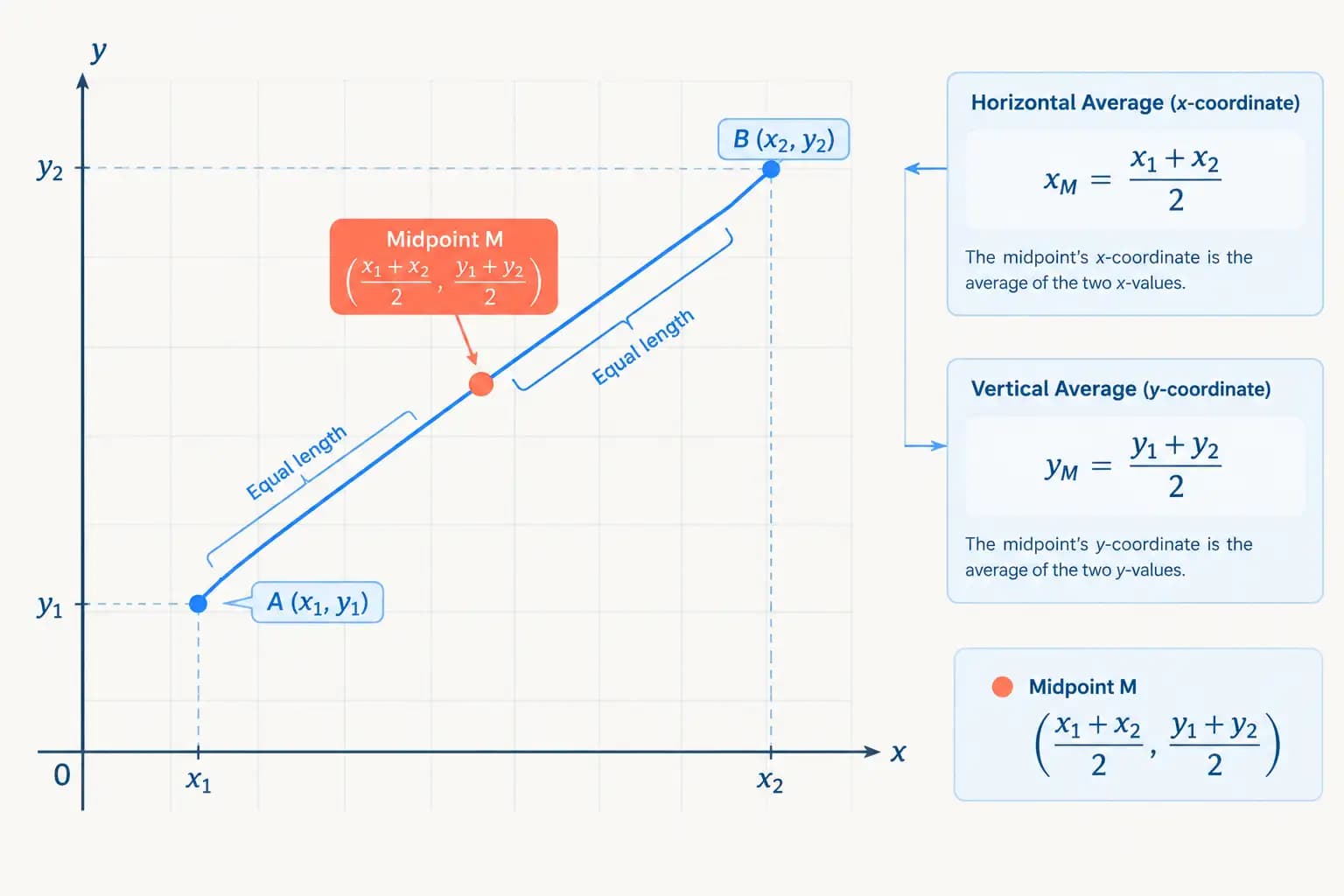
For two points in a two-dimensional plane, and , the midpoint formula is:
Where:
- and represent the horizontal and vertical coordinates of the first point.
- and represent the horizontal and vertical coordinates of the second point.
- represents the coordinate pair of the resulting center point.
Extending to 3D Coordinates
When your geometry problems or spatial designs include height or depth, add a third axis (). For points and , the three-dimensional formula is:
The arithmetic logic remains identical. Each axis calculates independently of the others.
How to Use This Midpoint Calculator
The calculator has four tabs, each answering a different question about the same segment:
- Midpoint: enter both endpoints and get the centre point.
- Endpoint: enter one endpoint and the midpoint, and recover the endpoint you are missing.
- Ratio: split the segment in any ratio instead of in half, with presets for the trisection and quarter points. A ratio of 1 to 1 is simply the midpoint.
- Values: the same halfway arithmetic on two plain numbers rather than coordinates, tracked across as many rounds as you like so you can watch two figures converge.
On the three coordinate tabs:
- Select your coordinate mode: choose either 2D or 3D .
- Enter the coordinates for Point A (, , and optional ). Whole numbers, decimals, negatives, fractions such as and mixed numbers such as all work.
- Enter the coordinates for Point B (, , and optional ).
- Results appear as you type, with no button to press. You get the midpoint as an exact fraction and as a decimal, the segment length in both decimal and exact radical form, the slope, the half distance, the squared distance, and the working set out step by step.
Reset Calculator at the foot of the input panel returns every field to its starting value, and Swap A and B exchanges the two endpoints without retyping them.
If you need to verify how far apart the two original points were before finding their center, check the output against our distance calculator for full Euclidean distance steps.
Midpoint Examples
Working through coordinate pairs by hand clarifies how the signs and division behave.
Example 1: Standard 2D Coordinates
Find the midpoint between Point A and Point B .
- Identify the input values: , , ,
Apply the horizontal midpoint equation:
Apply the vertical midpoint equation:
The midpoint coordinate is . The point sits directly halfway along the line segment between and .
Example 2: Negative Numbers and Fractions
Find the midpoint between Point A and Point B .
- Identify the input values: , , ,
Calculate the horizontal coordinate:
Calculate the vertical coordinate:
The midpoint coordinate is , or as a simplified fraction, .
Example 3: Three-Dimensional Spatial Coordinates
Find the midpoint between Point A and Point B .
- Identify the input values: , , , , ,
Calculate each coordinate axis:
The 3D midpoint coordinate is .
Finding a Missing Endpoint When the Midpoint is Known
Sometimes an exam problem or surveying plan provides one endpoint and the midpoint, requiring you to solve for the unknown second endpoint.
Rearrange the standard midpoint formula to isolate the missing point coordinates ():
Missing Endpoint Example
Suppose Point A is located at and the midpoint is known to be . Find Point B .
Substitute values into the rearranged horizontal formula:
Substitute values into the rearranged vertical formula:
Point B sits at . If you then connect and into our slope calculator, you can verify that the slope matches across each half of the segment.
Understanding the Difference Between Midpoint, Slope, and Distance
Coordinate geometry relies on three core calculations to describe line segments. Each answers a distinct geometric question:
| Measurement | Question Answered | Formula (2D) | Output Type |
|---|---|---|---|
| Midpoint | Where is the center point? | Coordinate Point | |
| Distance | How long is the segment? | Scalar Value (units) | |
| Slope | How steep is the segment? | Ratio / Rate of change |
The midpoint produces location coordinates. Distance produces a scalar length. Slope describes direction and angle of tilt.
Practical Applications Across Disciplines
Midpoint calculations extend beyond high school algebra homework. Real-world workflows depend on exact center coordinates daily:
- Computer Graphics and Game Design: Game engines calculate midpoints to place character anchors, position cameras between competing targets, and construct bounding collision volumes.
- Geographic Information Systems (GIS): Cartographers establish median reference marks along territorial borders, pipeline runs, and transit lines using geodetic midpoint formulas.
- Architecture and Carpentry: Builders find midpoints to locate structural load headers, space ceiling joists evenly, or establish ridge lines on gabled roofs.
- Urban Planning and Logistics: Delivery services place centralized distribution hubs by finding the geographic center between primary supplier nodes and retail clusters.
Common Mistakes to Avoid
Simple arithmetic habits cause the vast majority of midpoint errors:
- Subtracting instead of adding coordinates: The slope and distance formulas require subtraction (). The midpoint formula requires addition (). Mixing these operations is the single most frequent calculation mistake.
- Combining horizontal and vertical terms: Never add to . Horizontal coordinates combine strictly with horizontal coordinates ( with ), and vertical coordinates combine strictly with vertical coordinates ( with ).
- Dropping negative signs during addition: When adding negative numbers, remember that , not positive 12 or positive 4.
- Confusing the midpoint with segment length: A midpoint is an ordered pair identifying a position on a grid, not a scalar measurement of length.
- Rounding decimals prematurely: Keep exact fractional representations until all calculation steps finish to prevent rounding drift in multi-part physics problems.
Assumptions, Limitations, and Edge Cases
The standard Cartesian midpoint formula assumes flat, Euclidean geometric space:
- Identical Coordinates: If Point A and Point B share identical values (for example, and ), the line segment has zero length. The calculated midpoint simply returns .
- Curved Earth Surface Limitations: On large geographical scales, the shortest distance between two points follows the arc of a sphere or ellipsoid (a great circle). Calculating a mid-continent geographical midpoint using flat Cartesian coordinates produces spatial distortion. Spherical trigonometry or geodesic formulas are required for long-distance navigation.
- Unbounded Values: The formula accepts all real numbers from negative infinity to positive infinity. It does not handle undefined or imaginary numbers.
Frequently Asked Questions
What is the midpoint formula?
The midpoint formula calculates the average of coordinate pairs between two endpoints. In 2D, it is written as .
Can a midpoint have negative coordinates?
Yes. If the sum of the endpoint coordinates on any axis is negative, dividing by two produces a negative coordinate.
How do you find the midpoint if one point is the origin (0, 0)?
Divide the coordinates of the non-zero point by two. For Point A and Point B , the midpoint is simply .
Does it matter which point you label as Point 1 or Point 2?
No. Addition is commutative, meaning equals . Labeling either endpoint as Point 1 yields the exact same midpoint.
What is the difference between a midpoint and an average?
A midpoint is the geometric average of spatial coordinate pairs. It applies the concept of the standard arithmetic mean independently to horizontal, vertical, and depth dimensions.
How do you find the midpoint in 3D space?
Add the third axis into the calculation: . Each axis computes independently.
Can the midpoint formula be used for fractions and decimals?
Yes. This calculator accepts whole integers, negative numbers, decimals, proper and improper fractions such as , and mixed numbers such as . Decimals are converted to exact fractions internally rather than held as floating point, so the midpoint of and comes back as instead of a rounded 0.2667.
How do you find the midpoint of a vertical or horizontal line?
Apply the same standard formula. For a vertical line where , the horizontal midpoint remains that same value, while the vertical coordinate averages the two heights.