Rhombus Calculator
This rhombus calculator finds the area, perimeter, diagonals, height, and interior angles using any two known dimensions. Instead of spending time reorganizing trigonometric formulas or solving systems of quadratic equations by hand, you can enter your known values to get an immediate, step-by-step breakdown. It gives students, carpenters, tile setters, and quilters reliable geometric answers in seconds.
Shape
How it was solved
- 1Both values are already the base pair
- 2Fill in the rest
Consistency check

Created by Jose Smith
Last updated: September 28, 2026
How to Use this Rhombus Calculator
A rhombus has four equal sides, which means you only need two distinct measurements to solve for every other geometric property.
- Type your two known values straight into whichever fields you already have. There is no mode to choose first. Common pairs are side length and height, side length and an angle, or both diagonals.
- Watch the remaining seven fields fill themselves in. The two you typed are marked as given, and everything worked out from them is marked as solved.
- Select your preferred units of measurement (such as inches, centimeters, or feet).
- Review the computed values in the output panel. The calculator displays area, perimeter, altitude (height), both diagonals, all four internal angles, and the inradius of the circle that touches all four sides.
- Read the step-by-step card below the results to follow the exact mathematical pathway used for your numbers.
- Changed your mind? Type into any third field and the older of your two given values is released automatically, so there is never a field to clear first.
Geometric Properties of a Rhombus
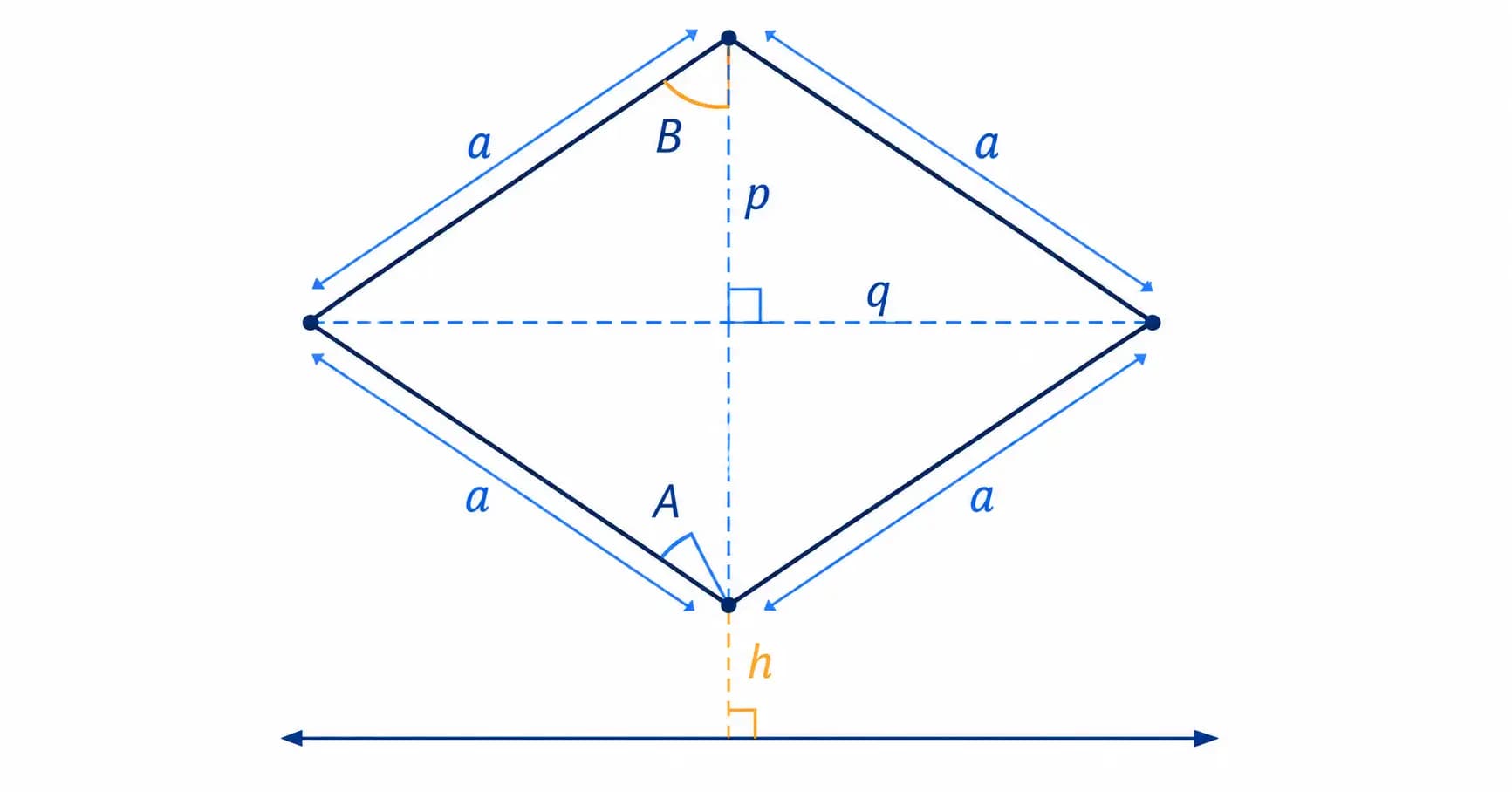
A rhombus is a quadrilateral with four sides of equal length. It belongs to the parallelogram family, which gives it several useful geometric behaviors:
- Opposite sides are parallel: Side AB runs parallel to side CD, and side BC runs parallel to side AD.
- Opposite angles are equal: The two acute angles match each other, and the two obtuse angles match each other.
- Consecutive angles are supplementary: Any two adjacent interior angles add up to 180 degrees.
- Diagonals bisect at right angles: The diagonals cut each other in half at an exact 90-degree angle. This property splits the rhombus into four identical right-angled triangles.
- Diagonals bisect interior angles: Each diagonal cuts its respective corner angles into two equal halves.
Core Rhombus Formulas
Depending on what measurements you start with, you can calculate the area, diagonals, and angles using several standard geometric formulas.
1. Side Length and Perimeter
Because all four sides () are identical:
If you know the two diagonals ( and ), you can find the side length using the Pythagorean theorem on one of the four internal right triangles:
2. Area Formulas
You can calculate the area () using three different methods based on your available inputs:
Using diagonals ( and ):
Using side length () and height ():
Using side length () and any interior angle ():
3. Diagonals and Angles
When working with side length () and an interior angle ():
Where represents the longer diagonal when is the acute angle, and represents the shorter diagonal.
The height () relates directly to the sine of the angle:
Worked Examples
Here are three real-world calculation scenarios demonstrating how different initial inputs produce full geometric profiles.
Example 1: Known Diagonals (Carpentry Layout)
Suppose you are framing a diamond-pattern decorative window panel. You measure the horizontal diagonal at 16 inches and the vertical diagonal at 12 inches.
Given: ,
Step 1: Calculate the area ():
Step 2: Calculate the side length ():
Step 3: Calculate the perimeter ():
Step 4: Calculate the height ():
Step 5: Calculate the interior acute angle ():
The obtuse angle () is:
Example 2: Known Side Length and Acute Angle (Tile Layout)
A ceramic floor tile features rhombus shapes with a side length of 8 centimeters and an acute corner angle of 60 degrees.
Given: ,
Step 1: Calculate the perimeter ():
Step 2: Calculate the height ():
Step 3: Calculate the area ():
Step 4: Calculate the diagonals ( and ):
Notice that when an angle is 60 degrees, the shorter diagonal equals the side length because the rhombus consists of two equilateral triangles joined base-to-base.
Example 3: Known Side Length and Height (Paving Paver)
A precast concrete paver has a side edge of 15 inches and a perpendicular height of 12 inches.
Given: ,
Step 1: Calculate the area ():
Step 2: Calculate the perimeter ():
Step 3: Calculate interior angles ( and ):
Step 4: Calculate diagonals ( and ):
To check surface slope or pitch on outdoor paver installations, pair these area dimensions with our slope calculator.
Practical Applications
Understanding rhombus geometry has practical value across several hands-on industries:
- Flooring and Masonry: Diamond patterns require exact edge cuts along walls. Knowing the diagonal lengths lets installers snap chalk lines on subfloors so every point aligns across the room.
- Quilting and Textile Design: Patchwork designs such as the "Lone Star" or "Tumbling Blocks" rely on diamond patches. Precise angle and side calculations ensure that eight or twelve fabric points meet flat in the center without puckering.
- Structural Truss Engineering: Rhombus frameworks appear in scissor lifts, folding security gates, and diamond trusses. Because the diagonals change length as the hinge angles shift while edge lengths remain fixed, engineers use these formulas to calculate mechanical clearance and load distribution.
- Graphic Design and Branding: Hexagonal isometric grids create 3D cube illusions using three identical rhombuses. Calculating height and diagonal ratios guarantees consistent 120-degree and 60-degree corner fits.
Common Mistakes to Avoid
A few frequent misconceptions can lead to incorrect calculations:
- Treating Height as Side Length: The height (altitude) is the perpendicular distance between two parallel sides. Unless the rhombus is an exact square with 90-degree corners, height is always strictly smaller than the side length (). Using side length in place of height overestimates surface area.
- Entering Angles Greater Than or Equal to 180 Degrees: A single interior corner of a convex quadrilateral cannot reach or exceed 180 degrees. If you enter an angle of 180 degrees, the shape collapses into a straight line.
- Mixing Angle Modes: Check whether your external references use degrees or radians. Trigonometric functions evaluated in radians instead of degrees will return incorrect sine and cosine values.
- Confusing a Rhombus with a General Parallelogram: While every rhombus is a parallelogram, not every parallelogram is a rhombus. A parallelogram can have adjacent sides of different lengths. In a rhombus, all four outer edges are identical.
- Assuming Diagonals Are Equal: Diagonals in a rhombus are only equal when all four interior angles are 90 degrees, forming a square. In every other case, one diagonal is longer than the other.
- Rounding Intermediate Values: When solving for diagonals via angles, keeping intermediate decimals avoids compounding errors. Round only your final numbers.
Edge Cases and Geometric Limitations
Our calculator implements strict boundary checks to protect calculation accuracy:
- Square as a Special Rhombus: When the interior angle equals 90 degrees, the rhombus becomes a square. In this state, , , and . The calculator handles this case smoothly without dividing by zero.
- Height Exceeding Side Length: If an input specifies a height greater than the side length (), the geometry is physically impossible. The calculator rejects this combination and asks for revised numbers.
- Angle Constraints: All input angles must sit strictly between 0 degrees and 180 degrees. Values of 0 or 180 create degenerate flat lines with zero area. Putting an obtuse value in the acute box is not an error: the calculator recognises which angle you meant and tells you what it did.
- Zero or Negative Dimensions: Negative edge lengths, heights, or diagonals cannot exist in physical space. All linear inputs must be positive real numbers ().
- Area vs. Side Incompatibility: If you provide area () and side length (), the area cannot exceed . A shape where would require , which is impossible in Euclidean geometry.
Frequently Asked Questions
Can a rhombus have four right angles?
Yes. When a rhombus has four 90-degree right angles, it is a square. A square is simply an equilateral rhombus with equal interior angles.
Why do the diagonals of a rhombus bisect each other at 90 degrees?
Because all four sides are equal, the diagonals form four congruent triangles through the side-side-side rule. The angles meeting at the center must sum to 360 degrees, which divides into four equal 90-degree right angles.
What is the minimum information needed to solve a rhombus?
You need at least two independent dimensions, and this calculator accepts all 33 pairs that qualify. Those include two diagonals, side length plus height, side length plus one angle, area plus a side, area plus a diagonal, height plus a diagonal, and the perimeter or inradius standing in for the side or the height. The only three it turns down are the pairs that say the same thing twice: side with perimeter, height with inradius, and the two angles with each other.
How do you find the height if you only know the diagonals?
First calculate the area using . Next, find the side length using . Finally, divide the area by the side length ().
What is the difference between a rhombus and a diamond?
"Rhombus" is the formal mathematical term for an equilateral parallelogram. "Diamond" is a lay term often used in card games, jewelry, or sports fields that typically refers to a rhombus placed on one of its pointed vertices.
Can you calculate rhombus dimensions with only the perimeter?
No. The perimeter only tells you that each side is one-fourth of the total distance (). You still need an angle, height, diagonal, or area to determine the shape's tilt.
Does a rhombus always have two lines of symmetry?
Yes. The two diagonals serve as lines of reflectional symmetry. A square has four lines of symmetry because its vertical and horizontal midlines also serve as reflection axes.
How do you convert degrees to radians if needed?
Multiply the degree value by and divide by 180. For instance, a 60-degree angle equals radians (approximately 1.0472 radians).