Ski Size Calculator
A ski size calculator determines the correct ski length for your body and skiing style. As a general rule, your ideal ski length falls between your chin and the top of your head, which translates to your height minus 5 to 15 centimeters. The exact length shifts based on your weight, skier ability, terrain preferences, and ski profile.
Comfortable on most blue runs at speed
A bit of everything, the default choice
Full edge contact, feels true to its measured length
Stood on end, this ski reaches between chin and nose
The old shop rule, and still a good sanity check before you buy.
How the number was built
| Your height | 175 cm is the starting point | 175 cm |
| Intermediate ability | Comfortable on most blue runs at speed | -13 cm |
| All-Mountain | A bit of everything, the default choice | 0 cm |
| Weight | 160 lb against a typical 139 to 159 lb band for your height | 0 cm |
| Average style | A mix of cruising and charging | 0 cm |
| Men's | No adjustment applied | 0 cm |
| Average | Typical recreational fitness | 0 cm |
| Traditional camber | Full edge contact, feels true to its measured length | 0 cm |
| Recommended | all adjustments applied | 162 cm |
| Terrain | Length | Waist width | Why |
|---|---|---|---|
| -5 cm | 68 to 80 mm | Narrow waist, tight turns, edge grip on firm groomers | |
| 0 cm | 85 to 100 mm | A bit of everything, the default choice | |
| +5 cm | 100 to 110 mm | High speeds, variable chop, off-piste steeps | |
| +10 cm | 110 to 125 mm | Maximum surface flotation in deep, untracked snow | |
| -5 cm | 82 to 95 mm | Shorter is easier to spin, land switch, and ride rails |

Created by Jordan Clarke
Last updated: September 25, 2026
How to Determine Your Baseline Ski Size
The starting point for sizing downhill skis begins with your total standing height in centimeters. If you measure your height in feet and inches, multiply your total inches by 2.54 to find your height in centimeters.
This baseline establishes a neutral, mid-point ski length. When you stand upright next to a ski of this length, the tip reaches roughly between your upper lip and your nose.
Your weight provides the first critical adjustment to this baseline. Skis do not know how tall you are, but they react directly to the downward pressure and flex you exert.
- Lighter than average for your height: Subtract 2 to 3 cm from your baseline.
- Average weight for your height: Keep your baseline as calculated.
- Heavier than average for your height: Add 2 to 3 cm to your baseline.
Ski manufacturers build a specific flex curve into each model. A heavier skier compresses a ski more deeply during a turn. If that skier picks a ski that is too short, the ski over-flexes, causing the edges to lose their bite across icy patches. Conversely, a lighter skier on a long, stiff plank will struggle to bend the core enough to engage the effective edge.
Beyond height, weight, ability, and terrain, three smaller factors fine-tune the final number: a more aggressive skiing style adds length for stability at speed while an easygoing style trims it for quicker turns, a fitter skier can comfortably drive a couple of extra centimeters that a less active skier would find tiring, and women's specific skis typically run about 2 cm shorter than a unisex or men's model at the same height because they are built with a softer, lighter flex.
Adjusting Ski Length for Experience Level
Ski ability changes how much leverage and speed you bring to the mountain. Beginners need skis that pivot effortlessly at low speeds, while aggressive experts need longer running surfaces to maintain edge hold at speed.
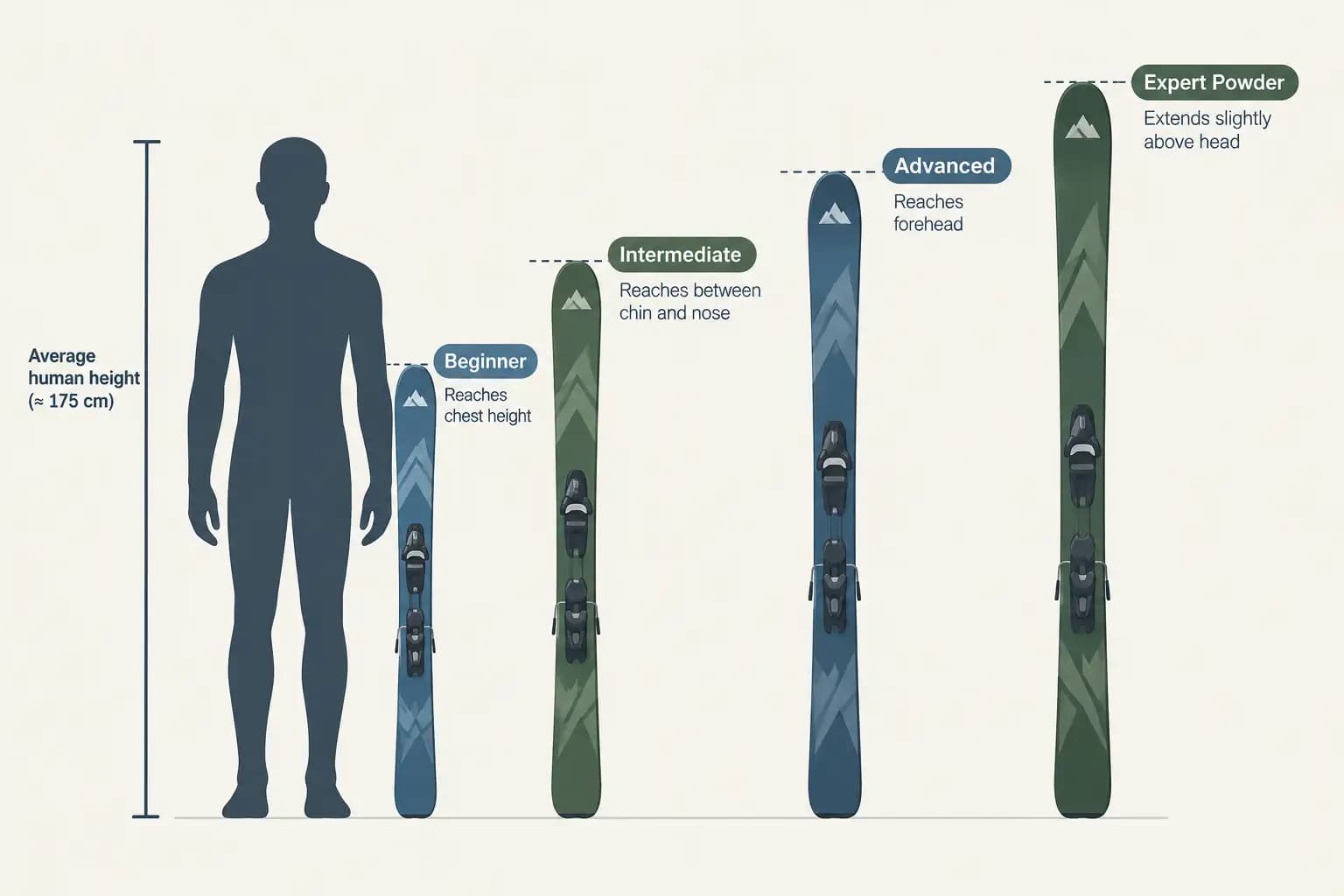
Beginner Skiers (-5 to -8 cm)
Beginners spend most of their time learning edge engagement, sliding turns, and managing speed on groomed green and gentle blue trails. A ski reaching your chest or chin requires minimal effort to initiate a turn. The shorter turning radius forgives balance errors and prevents the tips from crossing. If you are learning, choose a length that gives you immediate steering confidence.
Intermediate Skiers (-2 to -4 cm)
Intermediates ski blue runs comfortably, parallel turn on smooth terrain, and explore occasional ungroomed snow. A ski that reaches between your chin and your nose provides a balanced blend of maneuverability and edge hold. It remains stable as your cruising speed increases without demanding perfect athletic form in tight spots.
Advanced and Expert Skiers (+2 to +5 cm)
Advanced skiers carve clean arcs at high speeds, handle steep pitches, and charge through variable conditions like crust, bumps, and chop. A longer ski provides a longer effective edge, which cuts into hardpack like a rail. It also adds running surface area to absorb vibrations and float over soft snow. Experts choose skis that reach eye level, forehead level, or slightly above the crown of the head.
How Ski Terrain and Style Change Length
Where you ski directly influences the ski shape and length you should buy. Skiing tight trees in New England demands a completely different setup than tracking wide bowls in the Rocky Mountains.
| Ski Category | Typical Waist Width | Length Relative to Height | Primary Mountain Purpose |
|---|---|---|---|
| Carving / Frontside | 68 to 80 mm | Chin to nose (-10 to -15 cm) | Tight turns, edge grip on firm groomers |
| All-Mountain | 85 to 100 mm | Nose to eye level (-5 to -10 cm) | Versatility across groomed snow, bumps, and light powder |
| Freeride / Big Mountain | 100 to 110 mm | Eye level to head height (-2 to +2 cm) | High speeds, variable chop, off-piste steeps |
| Powder | 110 to 125 mm | Head height to +5 cm over head (0 to +7 cm) | Maximum surface floatation in deep, untracked snow |
| Freestyle / Park | 82 to 95 mm | Chin to nose (-5 to -10 cm) | Spins, rail slides, switch riding, low swing weight |
Carving and Frontside Skis
Piste and carving skis feature narrow waists and pronounced sidecuts designed to slice through groomed snow. Choose these skis on the shorter side, roughly between your chin and nose. A shorter frontside ski snaps into turns quickly and generates energetic rebound from edge to edge.
All-Mountain Skis
All-mountain models represent the middle ground of the ski world. They handle morning groomers, afternoon slush, tracked-out trees, and modest powder stashes. Size an all-mountain ski to reach between your nose and eyebrows. This length balances quickness in moguls with dampness on open groomers.
Freeride and Powder Skis
Deep snow requires surface area. Wide powder skis distribute your mass across a broader footprint so you ride within the top layer of snow rather than sinking to the base. Powder and big-mountain skis should reach the top of your head or several centimeters taller. The extra length prevents the tips from diving into deep snow when you lean forward into your boots.
Camber vs. Rocker: Why Profile Matters
Ski length measured with a tape measure does not tell the full story. What really controls your ski on snow is its effective edge: the actual section of metal edge touching the snow during a turn.
Traditional camber features an upward arch in the center of the ski with contact points near the tip and tail. When you step into the binding, your weight flattens the ski, engaging the entire edge against the snow. A 170 cm traditional camber ski feels true to length and requires precise steering.
Rocker, or reverse camber, bends the tips and tails upward earlier, away from the snow. On a flat surface, only the center portion of a rockered ski makes contact. A rockered ski that measures 180 cm might only have 155 cm of metal edge touching the snow on a groomed trail.
Because rockered tips float effortlessly and pivot with minimal ankle pressure, you can safely size up 5 to 8 cm longer in a rockered or tip-and-tail rockered ski than you would in a traditional flat-tail cambered ski. The extra length gives you float in soft snow, while the rockered shape keeps the ski feeling short and nimble on hardpack.
Worked Examples
Here are two common skier profiles showing how height, weight, ability, and ski construction interact to generate a recommended length.
Example 1: The Improving Intermediate All-Mountain Skier
- Skier Stats: Male, 5 feet 10 inches (178 cm), 165 lbs (75 kg, average weight)
- Ability: Intermediate
- Chosen Ski: All-Mountain ski with tip rocker and traditional camber underfoot
- Calculate Baseline: Baseline = 178 cm - 10 cm = 168 cm.
- Apply Weight Adjustment: 165 lbs is within the standard bracket for a 5'10" male: 0 cm adjustment.
- Apply Ability Adjustment: Intermediate level calls for -3 cm: 168 cm - 3 cm = 165 cm.
- Apply Profile Adjustment: The tip rocker shortens the running edge: Add +4 cm. 165 cm + 4 cm = 169 cm.
Recommended Size: 168 to 172 cm. Ski manufacturers generally build skis in 4 to 6 cm increments, so this skier should look for models labeled near 170 cm.
Example 2: The Aggressive Powder Skier
- Skier Stats: Female, 5 feet 6 inches (168 cm), 145 lbs (66 kg, slightly above average for height)
- Ability: Advanced / Expert
- Chosen Ski: Powder ski with deep tip-and-tail rocker, 108 mm waist
- Calculate Baseline: Baseline = 168 cm - 10 cm = 158 cm.
- Apply Weight Adjustment: Slightly higher weight requires more float: +2 cm. 158 cm + 2 cm = 160 cm.
- Apply Ability Adjustment: Advanced skier seeking speed and stability: +4 cm. 160 cm + 4 cm = 164 cm.
- Apply Profile and Terrain Adjustment: Deep powder design with twin rocker floats best when sized over head height: +8 cm. 164 cm + 8 cm = 172 cm.
Recommended Size: 170 to 175 cm. Even though 172 cm is taller than her standing height, the early rise tip and tail will make the ski handle like a 162 cm ski on firm trails.
Ski Sizing Chart for Adults
Use this quick-reference table to find your target ski length range based on standing height and skiing proficiency.
| Height (ft / in) | Height (cm) | Beginner (cm) | Intermediate (cm) | Advanced / Expert (cm) |
|---|---|---|---|---|
| 4'10" | 147 cm | 132 to 137 | 137 to 142 | 142 to 148 |
| 5'0" | 152 cm | 137 to 142 | 142 to 147 | 147 to 154 |
| 5'2" | 157 cm | 142 to 147 | 147 to 152 | 152 to 159 |
| 5'4" | 163 cm | 147 to 152 | 152 to 158 | 158 to 165 |
| 5'6" | 168 cm | 152 to 157 | 157 to 163 | 163 to 170 |
| 5'8" | 173 cm | 157 to 162 | 162 to 168 | 168 to 176 |
| 5'10" | 178 cm | 162 to 167 | 167 to 174 | 174 to 182 |
| 6'0" | 183 cm | 167 to 173 | 173 to 180 | 180 to 188 |
| 6'2" | 188 cm | 172 to 178 | 178 to 185 | 185 to 194 |
| 6'4" | 193 cm | 177 to 183 | 183 to 190 | 190 to 198 |
Sizing Skis for Kids and Juniors
Sizing skis for children requires a strict safety-first approach. Never buy skis that are intentionally too large with the goal of letting a child "grow into them."
Skis that are too long prevent young skiers from learning basic wedge stops and edge balance. The extra tip length crosses easily, leading to falls and reduced confidence on snow.
For young children aged 3 to 6 who are sliding on snow for the first time, select skis that reach between their chest and armpits. For older kids who can turn and stop independently, size the skis to their chin or mouth. Only experienced junior racers or advanced teen freeskiers should ride equipment that reaches their eyes or forehead.
Common Sizing Mistakes to Avoid
Choosing the wrong ski length usually happens when buyers rely on single-variable advice. Avoiding these four common errors will ensure your next pair matches your actual skiing habits.
Relying Strictly on Standing Height
Standing next to a ski in a retail store is a poor indicator of how it skis. Two skiers who both stand 5'10" can weigh 140 lbs or 210 lbs. The 210-pound skier will collapse the camber of a soft 165 cm ski, making it skittish and unstable at speed. Always evaluate weight alongside height.
Ignoring the Rocker Profile
Buying a heavily rockered powder ski using traditional carving ski measurements is a recipe for frustration. A rockered tip lifts off the snow early, reducing the working edge. If you buy a 165 cm ski with heavy tip and tail rocker, it will carve like a 150 cm ski on firm snow. Check the ski rocker profile and size up when rocker is pronounced.
Overestimating Ability Level
Buying skis designed for an expert when you are still mastering parallel turns slows your progression. Stiff, long skis demand high speeds, precise body positioning, and significant leg strength to bend. Skiing on gear that is too aggressive tires your quadriceps quickly and forces you into a defensive backseat posture.
Treating Skis and Snowboards Equivalently
Ski sizing relies on completely different biomechanical principles than snowboard sizing. Snowboard length is dictated primarily by rider weight and stance width, whereas ski sizing balances height, leverage, and forward edge driving across two independent planks. Do not use snowboard sizing metrics to choose a pair of skis.
When to Size Up or Size Down
When your final calculations land right between two manufactured lengths (such as 168 cm and 176 cm), use this checklist to make your final choice.
Choose the shorter ski length if you:
- Want quick, effortless turns at moderate speeds.
- Spend most of your ski day in tight moguls, tree runs, or steep chutes.
- Are lighter than average for your height.
- Prefer carving tight slalom-style arcs on groomers.
- Are returning to the sport after a long break or recovering from injury.
Choose the longer ski length if you:
- Ski fast on open, wide trails.
- Weigh more than average for your height.
- Ski primarily off-piste in deep snow, chop, and wind crust.
- Are buying a ski with significant tip and tail rocker.
- Want maximum dampness and stability through variable snow.
Frequently Asked Questions
What happens if my skis are too long?
Skis that are too long feel heavy to turn and resist quick directional changes in moguls or tight trees. They demand aggressive forward pressure on your boot tongues and make slow-speed maneuvers physically exhausting.
What happens if my skis are too short?
Skis that are too short become unstable and chatter when you reach higher speeds on firm snow. They offer less surface area to float in powder and can feel twitchy when you try to hold a long, sweeping carved turn.
Do men and women need different ski length calculations?
Men and women use the same mechanical sizing rules based on height, weight, and ability. However, women's specific skis often feature lighter wood cores, softer flex patterns, and binding mount points shifted slightly forward to match a woman's natural center of gravity.
How does ski waist width affect the length I should pick?
Narrower skis (under 85 mm) are designed for firm snow and carve best at moderate, nimble lengths. Wider skis (over 100 mm) benefit from longer lengths because the extra length complements the wide surface area needed for powder flotation.
Can I use my shoe size to choose ski length?
Shoe size has no direct relationship to ski length. Your shoe size determines your ski boot shell size and binding sole length, while ski length is dictated by your height, weight, skill level, and terrain.
How do I size skis with twin tips?
Twin-tip skis curl upward at both the tip and the tail, which drastically reduces the length of edge touching the snow. Always size twin-tip freestyle skis 3 to 5 cm longer than standard directional flat-tail skis.